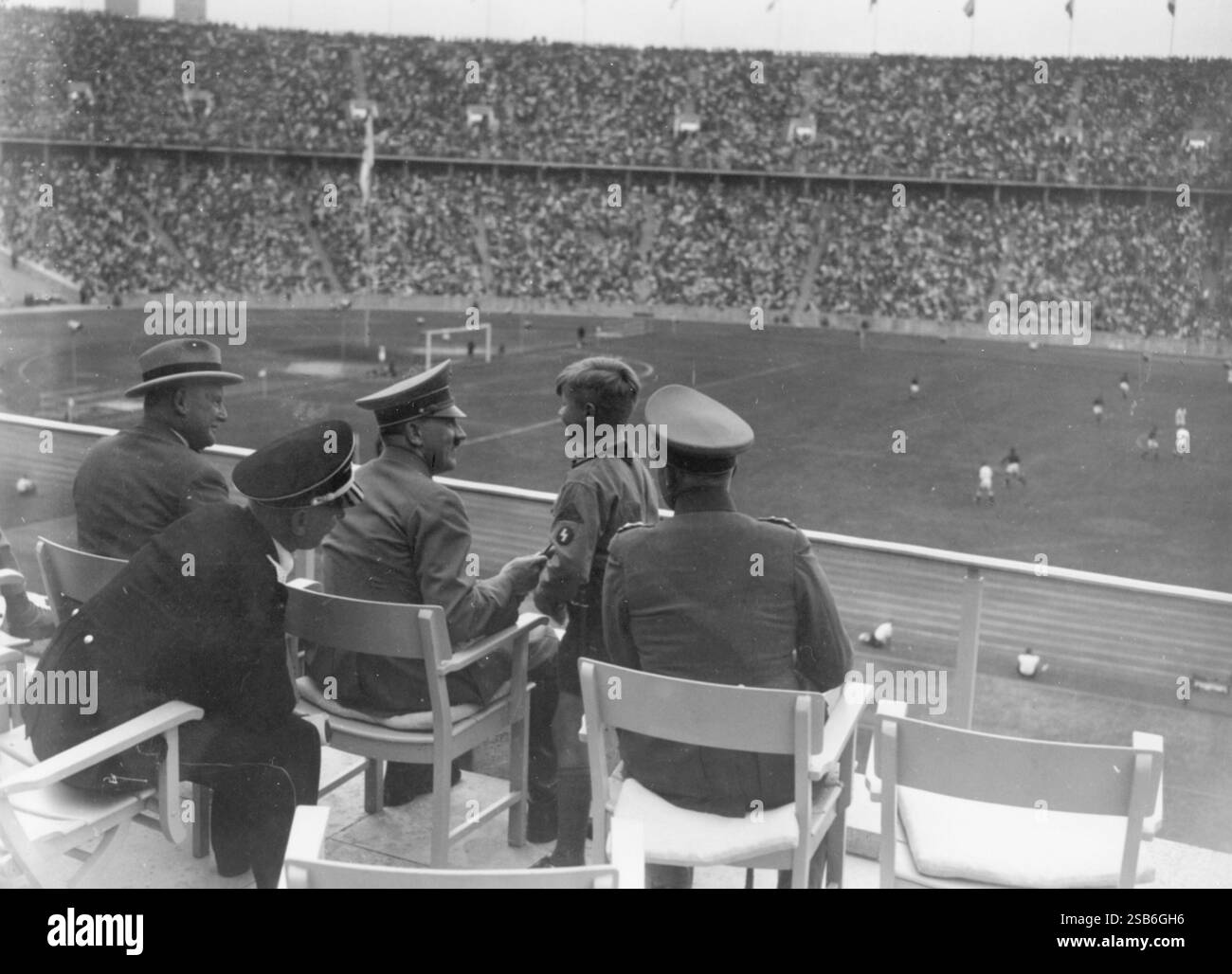
Adolf Hitler dans les tribunes des Jeux olympiques de 1936 à Berlin. Les Jeux olympiques de 1936 à Berlin sous la dictature nazie d'Adolf Hitler étaient plus qu'un événement sportif mondial, ils étaient aussi un spectacle de propagande nazie.
3340 x 2411 px | 28,3 x 20,4 cm | 11,1 x 8 inches | 300dpi
Date de la prise de vue:
23 juin 2021
Lieu:
Germany
Informations supplémentaires:
Cette image peut avoir des imperfections car il s’agit d’une image historique ou de reportage.
Adolf Hitler[a] (20 April 1889 – 30 April 1945) was an Austrian-born German politician who was the dictator of Nazi Germany from 1933 until his suicide in 1945. He rose to power as the leader of the Nazi Party, becoming the chancellor in 1933 and then taking the title of Führer und Reichskanzler in 1934.[d] His invasion of Poland on 1 September 1939 marked the start of the Second World War. He was closely involved in military operations throughout the war and was central to the perpetration of the Holocaust: the genocide of about six million Jews and millions of other victims. Hitler was born in Braunau am Inn in Austria-Hungary and was raised near Linz. He lived in Vienna in the first decade of the 1900s before moving to Germany in 1913. He was decorated during his service in the German Army in World War I, receiving the Iron Cross. In 1919, he joined the German Workers' Party (DAP), the precursor of the Nazi Party, and in 1921 was appointed leader of the Nazi Party. In 1923, he attempted to seize governmental power in a failed coup in Munich and was sentenced to five years in prison, serving just over a year of his sentence. While there, he dictated the first volume of his autobiography and political manifesto Mein Kampf (My Struggle). After his early release in 1924, Hitler gained popular support by attacking the Treaty of Versailles and promoting pan-Germanism, antisemitism, and anti-communism with charismatic oratory and Nazi propaganda. He frequently denounced communism as being part of an international Jewish conspiracy. By November 1932, the Nazi Party held the most seats in the Reichstag, but not a majority. No political party was able to form a majority coalition in support of a candidate for chancellor. Former chancellor Franz von Papen and other conservative leaders convinced President Paul von Hindenburg to appoint Hitler as chancellor on 30 January 1933.