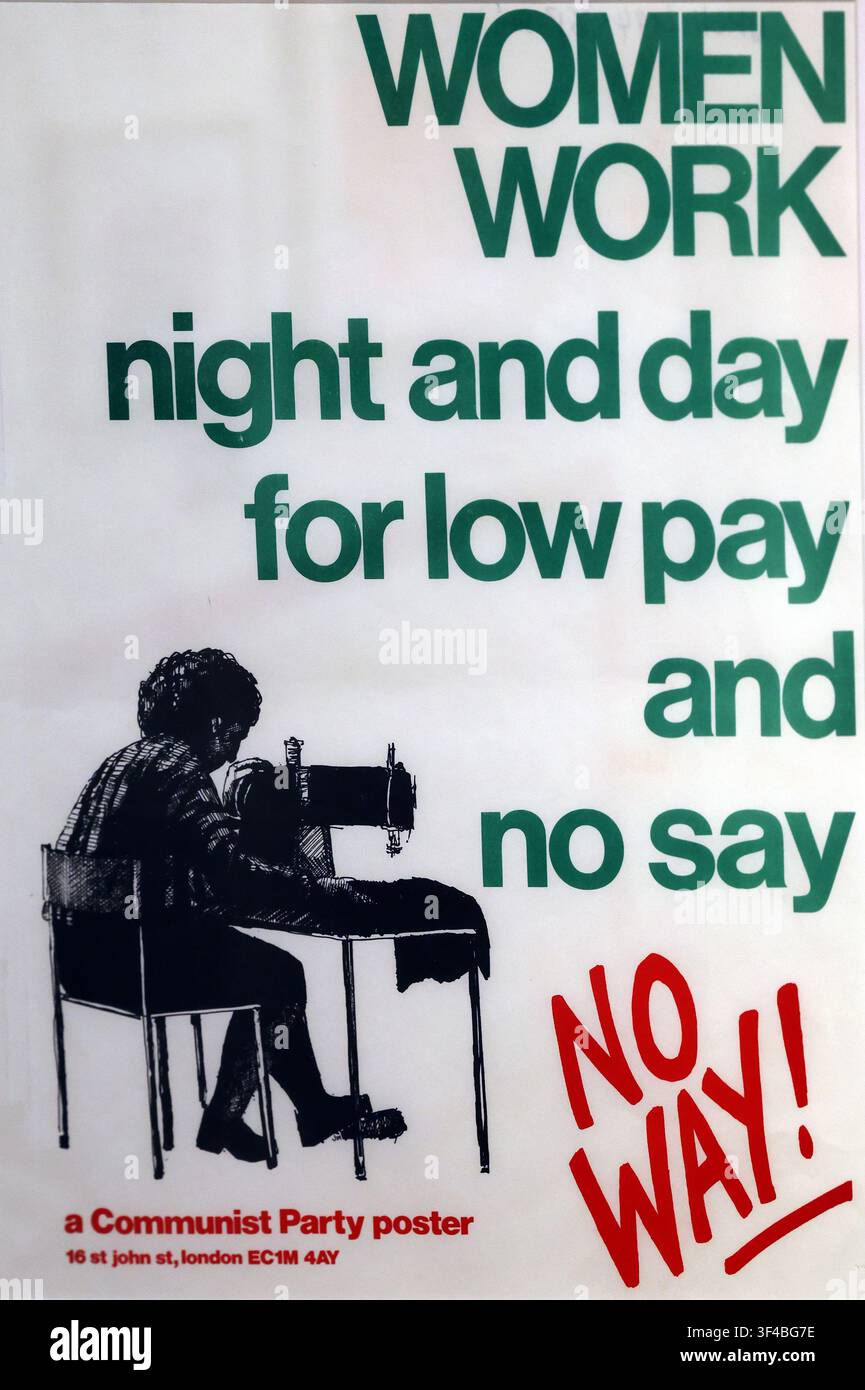
Affiche du Parti communiste pour l'égalité des salaires, faisant campagne pour les droits des travailleuses et des salaires équitables en Grande-Bretagne vers la fin des années 1960 / 1970.
3208 x 4816 px | 27,2 x 40,8 cm | 10,7 x 16,1 inches | 300dpi
Date de la prise de vue:
25 juillet 2026
Lieu:
United Kingdom
Informations supplémentaires:
Communist Party of Great Britain poster campaigning against women’s low pay and lack of workplace power, using the blunt slogan “Women Work night and day for low pay and no say” with the defiant response “NO WAY!” and an image of a woman at a sewing machine. The People’s History Museum dates this poster to around the 1980s, placing it within a long British struggle for women’s equal pay that had already produced landmark industrial action and legislation but was far from resolved. A decisive moment came in 1968 when 187 women sewing machinists at Ford’s Dagenham plant struck after their work was graded below comparable male jobs. They initially returned on 92% of the male rate, but their dispute helped turn equal pay into a national political issue. Women trade unionists subsequently organised an Equal Pay demonstration in Trafalgar Square in 1969, and the campaign contributed directly to the Equal Pay Act 1970. The Act received Royal Assent in May 1970 but did not take effect until December 1975, alongside the Sex Discrimination Act. Legal reform did not end the battle: occupational segregation, undervaluing of jobs traditionally done by women, unequal grading, part-time working patterns and discriminatory workplace cultures continued to sustain a gender pay gap. The Ford machinists themselves were not recognised as skilled workers until another strike in 1984. This Communist Party poster therefore belongs to the continuing phase of the equal-pay struggle, when campaigners were pressing beyond the existence of legislation towards equality in practice. Its sewing-machine imagery evokes women concentrated in lower-paid manufacturing and garment work, while “low pay and no say” connects wages with women’s limited power in workplaces and trade unions. The poster is a vivid record of labour history, feminism, industrial relations, trade-union activism and the unfinished campaign for equal economic status, fair job evaluation and equal treatment at work.