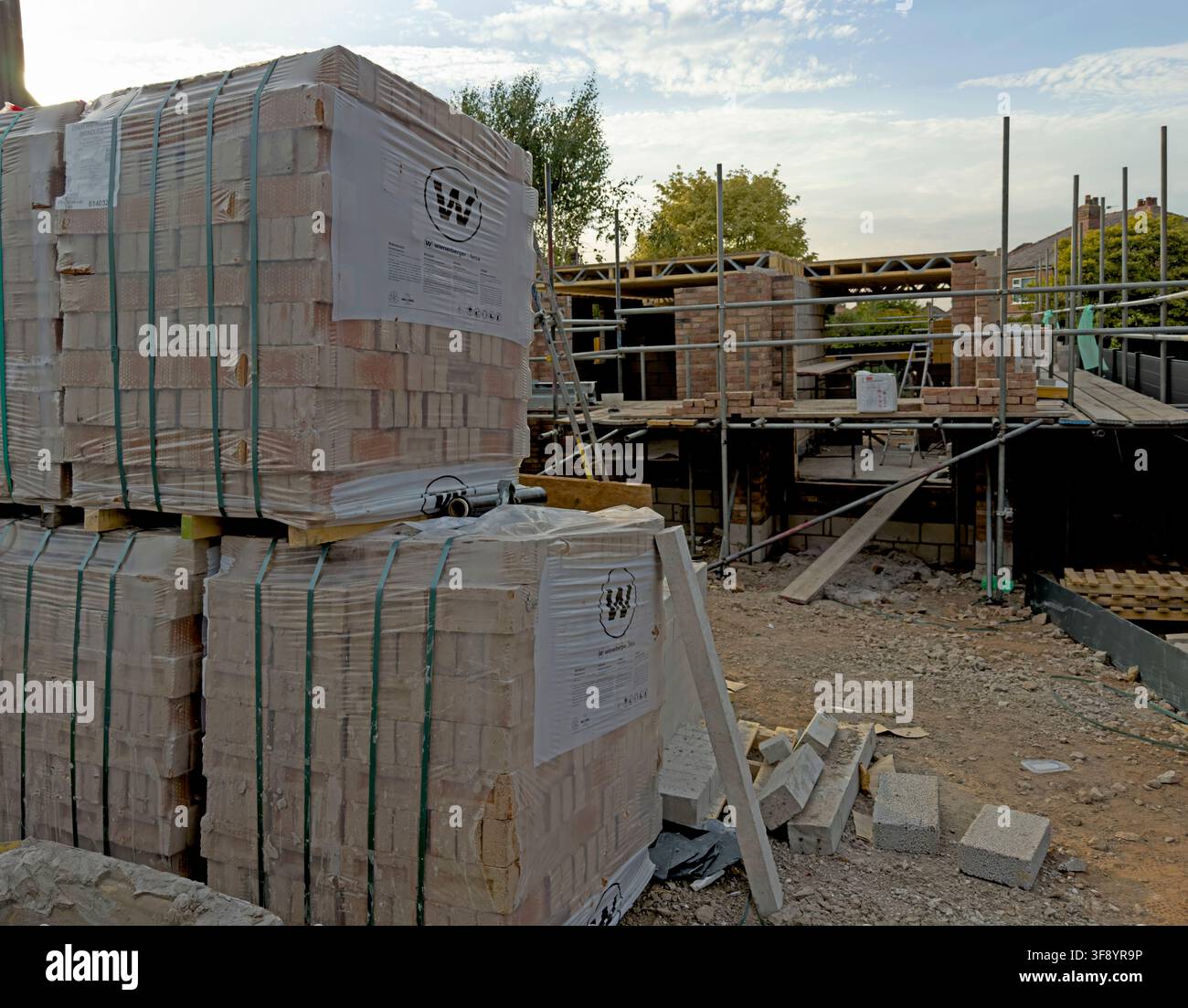
Alors que le Parti travailliste promet un boost, chantier de construction de logements neufs avec maçonnerie en bloc, échafaudages et matériaux de construction à Cheshire, Angleterre, Royaume-Uni.
6176 x 4813 px | 52,3 x 40,8 cm | 20,6 x 16 inches | 300dpi
Date de la prise de vue:
13 août 2026
Lieu:
Cheshire, England, UK
Informations supplémentaires:
A new-build housing construction site in Warrington, Cheshire, England, with stacks of concrete blocks, timber floor joists, scaffolding and partially completed walls illustrating the practical challenge of increasing Britain's supply of council, social and affordable homes. The image has particular editorial relevance on 25 August 2026 as Labour Prime Minister Andy Burnham and Housing Secretary Angela Rayner announce the first major allocations from the government's £39 billion, ten-year Social and Affordable Homes Programme. Nearly £10 billion is being allocated to 33 strategic partners outside London, including councils, housing associations and other providers, supporting 73, 600 new social and affordable homes, with nearly two-thirds expected to be for Social Rent. The government says the programme is intended to put councils back at the heart of housebuilding and achieve the largest expansion of council housing in decades, alongside a wider ambition to deliver 1.5 million homes during the Parliament. Greater Manchester is expected to receive around £529 million of strategic partnership investment supporting about 4, 400 homes, while further funding will be allocated over the programme's lifetime. The policy reflects renewed political emphasis on secure low-cost rented housing as waiting lists, homelessness and temporary accommodation place increasing pressure on local authorities and households. This unfinished residential development, with pallets of masonry blocks in the foreground and trades working around a scaffolded structure, represents the construction, skills, materials, finance and delivery capacity required to turn national housing pledges into completed homes. It also illustrates the wider debate around housing supply, affordability, planning, land availability, development costs, local authority building programmes and the role of housing associations in tackling England's long-running housing shortage.