4500 x 3583 px | 38,1 x 30,3 cm | 15 x 11,9 inches | 300dpi
Date de la prise de vue:
2 avril 2026
Informations supplémentaires:
Droits d’accès uniquement. Il s’agit d’une image de type document ou relevant du domaine public fournie par un tiers. Alamy accorde l’accès au fichier numérique, mais ne fournit aucune garantie concernant le droit d’auteur ou les droits moraux. Toute altération, modification ou recadrage est interdit sans autorisation préalable. Toute utilisation commerciale nécessite une autorisation préalable du fournisseur de contenu.
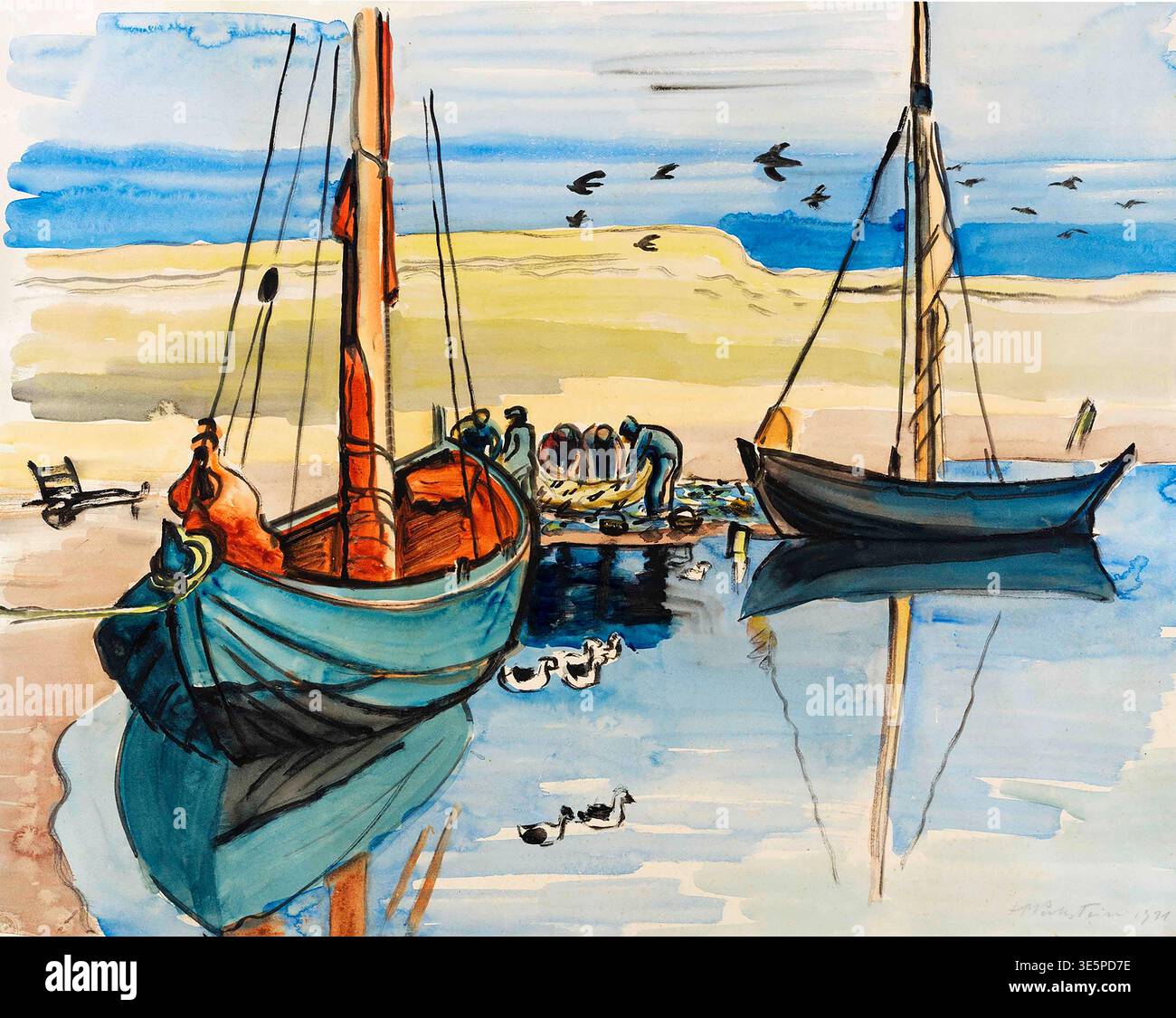
Hermann Max Pechstein was a German expressionist painter and printmaker and a member of the Die Brücke group. He fought on the Western Front during World War I and his art was classified as Degenerate Art by the Nazis. More than 300 paintings were removed from German Museums during the Nazi era. Pechstein was born in Zwickau, the son of a craftsman who worked in a textile mill. The family of eight lived on the father's salary. An early contact with the art of Vincent van Gogh stimulated Pechstein's development toward expressionism. He first worked as a decorator in his home town before enrolling at the School of Applied Arts and then at the Royal Art Academy in Dresden, where he met the painter Otto Gussman and the architect Wilhelm Kreis. It was here, starting in 1902, that he became a pupil of Gussmann; a relationship that lasted until 1906 when Pechstein met Erich Heckel and was invited to join the art group Die Brücke. He was the only member to have received formal art training. He was an active member of the Brücke until 1910 and often worked alongside Brücke painters creating a homogeneous style of this period. In 1905 he was in Dresden where the museum of ethnology showed wood carvings from the South Seas. As a result he developed his first woodcut.