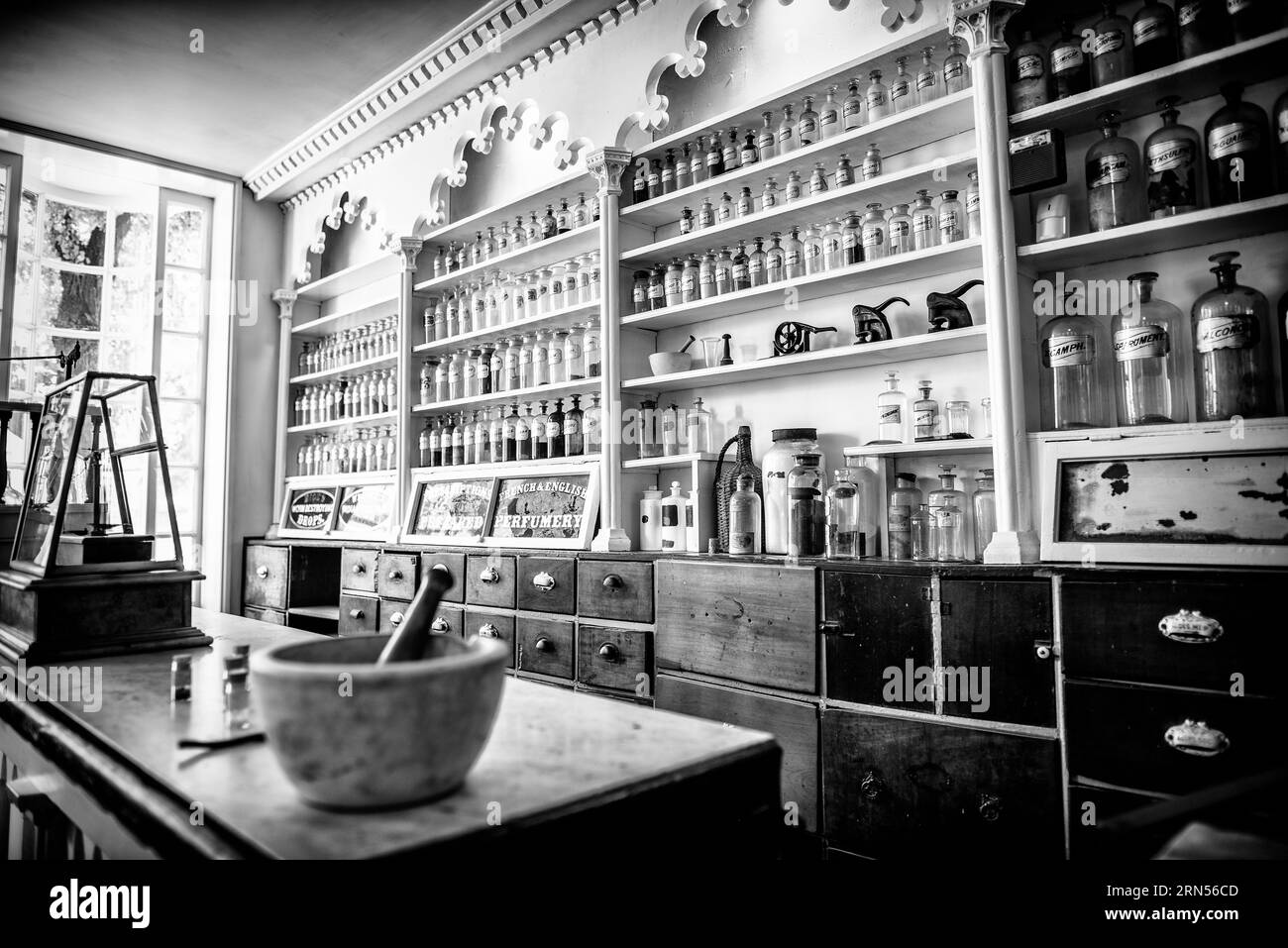
Bouteilles de médicaments antiques et mortier, Stabler-Leadbeater Apothecary Museum, Alexandrie. Photographie en noir et blanc montrant des étagères remplies de bouteilles en verre et un mortier et un pilon au premier plan.
7360 x 4912 px | 62,3 x 41,6 cm | 24,5 x 16,4 inches | 300dpi
Date de la prise de vue:
12 juillet 2018
Lieu:
Stabler-Leadbeater Apothecary Museum, Washington DC, District of Columbia, United States
Informations supplémentaires:
Photograph by David Coleman. The Stabler-Leadbeater Apothecary Museum in Alexandria, Virginia, stands as a testament to early American pharmaceutical history. Established in 1792 by Edward Stabler, the apothecary operated continuously as a family business until 1933, when economic hardships forced its closure. The museum, now a National Historic Landmark, preserves the shop's interior as it appeared in the early 20th century, offering visitors a glimpse into the evolution of pharmacy practices over nearly 150 years. The museum's collection includes over 8, 000 objects, featuring hand-blown glass bottles, ceramic jars, medical instruments, and a vast array of botanical materials used in compounding medicines. Many of these items remain in their original locations, creating an authentic atmosphere that transports visitors back in time. The apothecary's ledgers, which date back to its founding, provide valuable insights into the medical treatments and customer base of the era. Notable patrons of the Stabler-Leadbeater Apothecary included George and Martha Washington, and Robert E. Lee. The museum offers guided tours that highlight the building's architecture, the family's history, and the changing nature of medical practices from the colonial period through the early 20th century. Educational programs and interactive exhibits allow visitors to explore the connections between historical remedies and modern pharmaceutical science, making the museum a unique resource for understanding the development of American healthcare.
Uniquement disponible pour une utilisation éditoriale.
Utilisation pour des reportages d’actualités, des avis et des critiques, la communication d’informations concernant des personnes, des lieux, des choses ou des événements.
Par souci de clarté, l’utilisation éditoriale exclut tout usage en rapport avec la publicité, la promotion (par exemple, des sites web promotionnels), le marketing, les emballages ou les produits dérivés.