Ce guide fournit une étude populaire sur les arbres indigènes, offrant des descriptions détaillées de leurs habitudes et de leurs caractéristiques. Il constitue une ressource essentielle pour l'identification des arbres et la compréhension de leurs rôles écologiques. Le livre se concentre sur les espèces communes en Amérique du Nord et leurs caractéristiques distinctives.
1036 x 2411 px | 17,5 x 40,8 cm | 6,9 x 16,1 inches | 150dpi
Informations supplémentaires:
Droits d’accès uniquement. Il s’agit d’une image de type document ou relevant du domaine public fournie par un tiers. Alamy accorde l’accès au fichier numérique, mais ne fournit aucune garantie concernant le droit d’auteur ou les droits moraux. Toute altération, modification ou recadrage est interdit sans autorisation préalable. Toute utilisation commerciale nécessite une autorisation préalable du fournisseur de contenu.
Cette image peut avoir des imperfections car il s’agit d’une image historique ou de reportage.
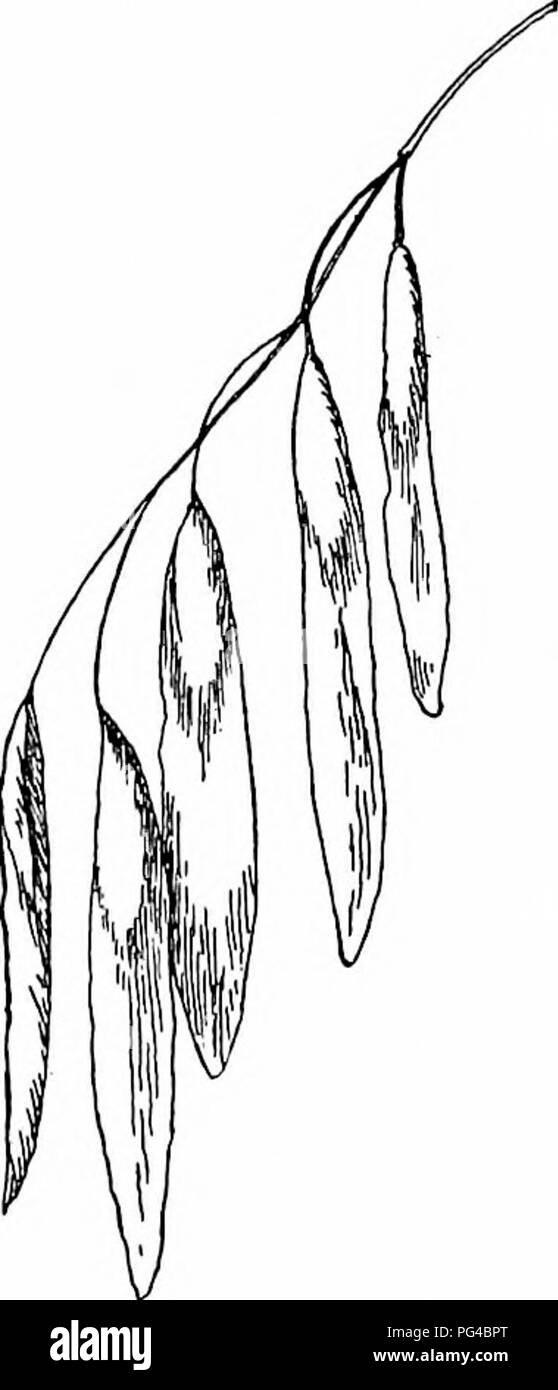
. Our native trees and how to identify them : a popular study of their habits and their peculiarities . Trees. OLIVE FAMILY Flowers.—May, before the leaves ; Dioecious, borne in lengthened panicles near the end of the branches, in axils of last year's leaves. Pedicels smooth; bracts varying in size and form. Calyx.—Campanulate ; in staminate flower slightly four-iobed ; in pistillate flower deeply lobed. Corolla.—Wanting. Stamens.—Two, rarely three ; filaments, short ; an- thers large, oblong, reddish purple. Pistil.—Ovary superior, two-celled, oval, contracted into a long slender style, with two spreadmg dark pur- ple stigmatic lobes. Fruit.—Samaras, borne in crowded drooping pan- icles si. to eight inches long, these hang upon the leafless branches until midwinter. The samaras vary in length from one to two inches. Body terete, pointed, margin- less below, abruptly dilated into a lanceolate or linear wing, acute or emarginate at apex. August, Septem- ber. Cotyledons elliptical. A Staminate and a Pis- tillate Flow- er oi White Ash, Frax- tmts amcri- cana ; en- larged. The White Ash is the most beautiful of all the American species. Its common name refers to the pale sometimes silvery under surface of the leaf and its specific name amer- icana fully distinguishes it as the best of its type. Its fibrous roots enable it to flourish in a soil, rich but shal- low', and oftentimes it may be seen clinging to rocks where with diffi- culty it can obtain a foothold. In the eastern and middle states it has proved itself an admirable city tree, but it has not been successfully planted in the prairie regions of the west, being unable to withstand the severe droughts to which they are subject. In appearance the young tree is singularly graceful. The slender grayish trunk, the easy sweep of its branches, the 208. Samaras of White Ash, Fraxhms americana.. Please note that these images are extracted from scanned page images that may have been digitally enhanced for rea