Ce guide met l'accent sur la nutrition animale, en particulier l'alimentation et la gestion du bétail et de la volaille, en mettant l'accent sur l'herbe des Bermudes, sa valeur nutritive et les meilleures pratiques agricoles pour le soin des pâturages.
2361 x 1058 px | 40 x 17,9 cm | 15,7 x 7,1 inches | 150dpi
Informations supplémentaires:
Droits d’accès uniquement. Il s’agit d’une image de type document ou relevant du domaine public fournie par un tiers. Alamy accorde l’accès au fichier numérique, mais ne fournit aucune garantie concernant le droit d’auteur ou les droits moraux. Toute altération, modification ou recadrage est interdit sans autorisation préalable. Toute utilisation commerciale nécessite une autorisation préalable du fournisseur de contenu.
Cette image peut avoir des imperfections car il s’agit d’une image historique ou de reportage.
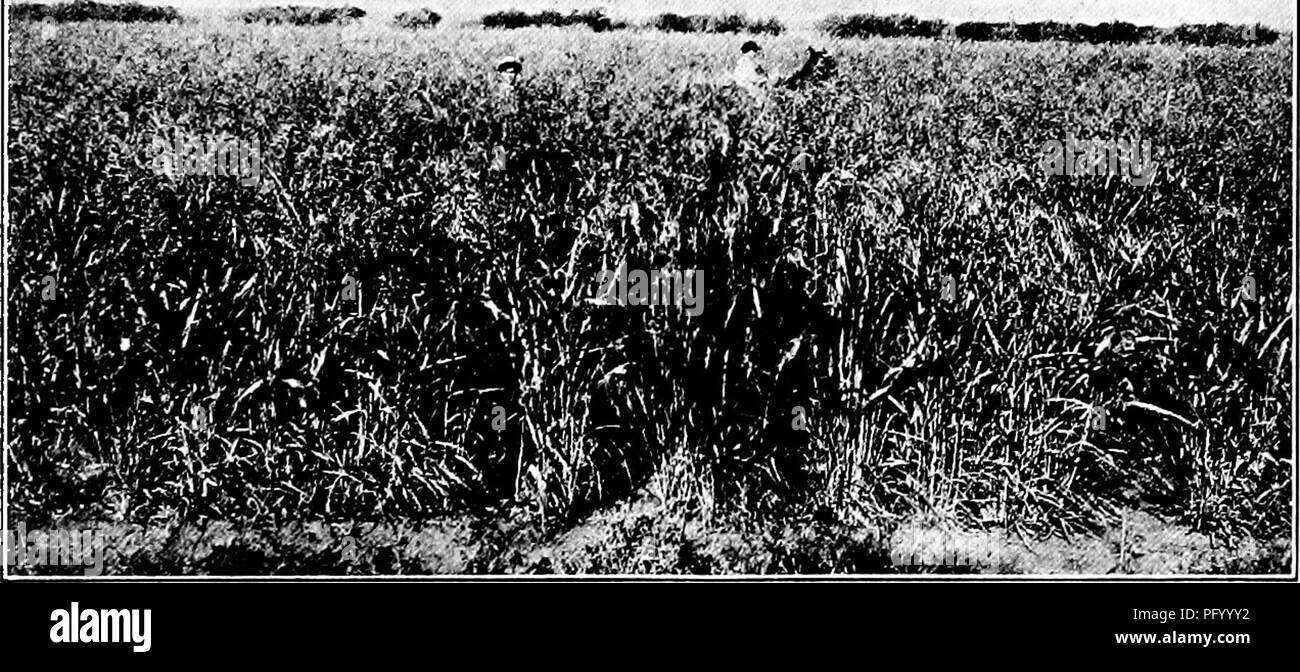
. Feeds and feeding abridged : the essentials of the feeding, care, and management of farm animals, including poultry : adapted and condensed from Feeds and feeding (16th ed.). Feeds; Animal nutrition. THE SMALLER GRASSES—STRAW 173 states. Bermuda forms a dense sod and serves best when closely grazed, as otherwise it becomes tough and wiry. It drives out most other grasses, but lespedeza or white clover will nourish in spots and improve the pasture. It furnishes pasturage from April to October and in winter, when it is dormant, the sod may be seeded with bur clover, hairy vetch, or Italian rye grass. Tho primarily a pasture plant, on rich soil Bermuda yields from three to four tons per acre of hay equal to timothy in value, tho the average is not over one ton. Johnson grass.—In the South this plant is the worst weed of the Blip 11. Fig. 49.—Sudan Grass—A New Crop op Much Promise This close relative of the sorghums is giving excellent results as a hay crop in the semi-arid districts and may prove' superior to the millets as a catch crop in the northern states. (From U. S. Department of Agriculture.) cotton planter and yet the best meadow grass for many sections. Its vigorous creeping rootstalks make it difficult to eradicate when once established and it is therefore not usually sown on clean fields. From two to three tons per acre is the average yield of Johnson grass cut for hay, but 6 tons per acre has been reported. It should be cut before maturity. Tho too coarse for pasture, Johnson grass may be cut once a month during the summer for soilage. Sudan grass, —This close relative of the sorghums was introduced into this country by the United States Department of Agriculture. Please note that these images are extracted from scanned page images that may have been digitally enhanced for readability - coloration and appearance of these illustrations may not perfectly resemble the original work.. Henry, W. A. (William Arnon), 1850-1932; Morrison, F. B. (Frank Ba