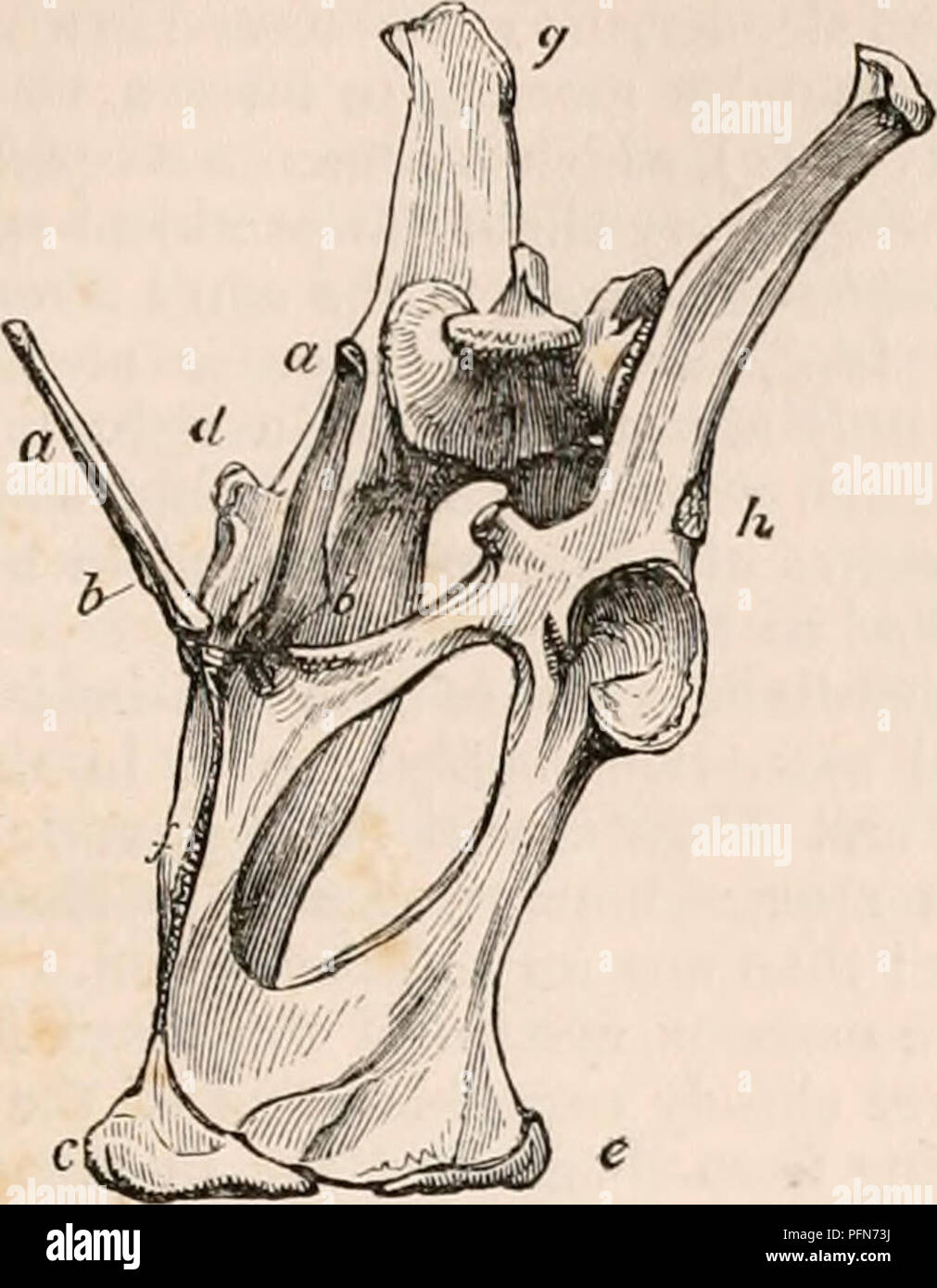
Ce travail de référence complet sur l'anatomie et la physiologie discute de la structure pelvienne de divers marsupiaux, comparant les os et les différences anatomiques chez les kangourous, Phascogale et Potoroo.
1394 x 1792 px | 23,6 x 30,3 cm | 9,3 x 11,9 inches | 150dpi
Informations supplémentaires:
Droits d’accès uniquement. Il s’agit d’une image de type document ou relevant du domaine public fournie par un tiers. Alamy accorde l’accès au fichier numérique, mais ne fournit aucune garantie concernant le droit d’auteur ou les droits moraux. Toute altération, modification ou recadrage est interdit sans autorisation préalable. Toute utilisation commerciale nécessite une autorisation préalable du fournisseur de contenu.
Cette image peut avoir des imperfections car il s’agit d’une image historique ou de reportage.
. The cyclopædia of anatomy and physiology. Anatomy; Physiology; Zoology. PELVIS. 161 (/) in the Kangaroo, Phascogale, and Potoroo, is not parallel with the spinal column, but Fig. 99.. Pelvis of the Kangaroo, showing the marsupial bones (a «) and inter-sciatic eplphysis (c). oblique in the opposite direction to the human symphysis, so that if prolonged forwards the line of direction would cut the spinal column at an obtuse angle. This makes the posterior opening larger in its antero-posterior diameter than it otherwise would be, and allows for the great encroachment of the caudal ver- tebra posteriorly. The sciatic notch is long and narrow, corresponding to the great length of theischia ; and the foramen obturatorium is large and elongated antero-posteriorly from the same cause. In the Daxynrus and Pe- tnunsts, the ischio-pubic symphysis is oblique in the opposite direction. The antero-pos- terior diameter of the anterior outlet in the Kangaroo is greater than the transverse by about half an inch ; but at the posterior outlet, the transverse is a little greater, from the pro- jection of the caudal spines before mentioned. The pelvic cavity is deep in the Marsupialia, and its openings are small in proportion to the size of the animal, since the foetus is expelled before it is full grown, and placed on the nipples in the marsupial pouch to complete its deve- lopment into a state of independent existence. But the proportion between the pelvic open- ings and the size of the foetal head, at the period of expulsion, is very remote. Even in the Petaurists, whose pelves are the smallest, the cavity and openings are six times the size of the foetal head. The muscles of the tail and "legs attached to the pelvis are, in the Kangaroos, very powerful to perform their prodigious leaps, especially the gracilis and biceps. The glutei, however, are not large, since the trunk is not held erect on the legs by these muscles, but is suspended, as it were, between the femurs, and