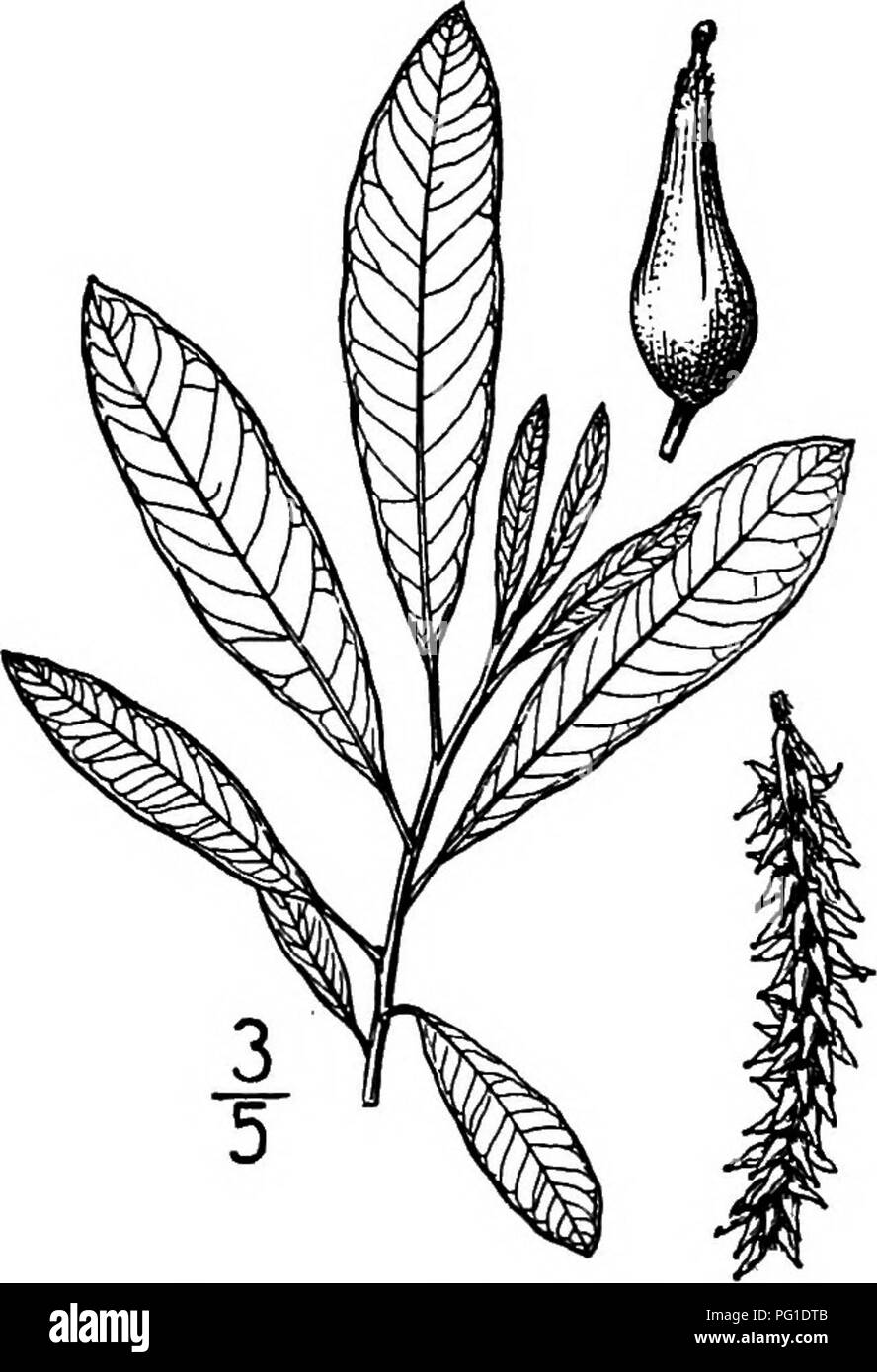
Ce travail fournit des descriptions détaillées et des illustrations d’arbres indigènes en Amérique du Nord, en mettant l’accent sur les espèces qui poussent naturellement sans culture. Il comprend des détails sur le saule de Bebb, ses caractéristiques et ses motifs de floraison.
1307 x 1912 px | 22,1 x 32,4 cm | 8,7 x 12,7 inches | 150dpi
Informations supplémentaires:
Droits d’accès uniquement. Il s’agit d’une image de type document ou relevant du domaine public fournie par un tiers. Alamy accorde l’accès au fichier numérique, mais ne fournit aucune garantie concernant le droit d’auteur ou les droits moraux. Toute altération, modification ou recadrage est interdit sans autorisation préalable. Toute utilisation commerciale nécessite une autorisation préalable du fournisseur de contenu.
Cette image peut avoir des imperfections car il s’agit d’une image historique ou de reportage.
. North American trees : being descriptions and illustrations of the trees growing independently of cultivation in North America, north of Mexico and the West Indies . Trees. Fig. 166. — Bebb's Willow. glandular-toothed, sometimes i cm. long or more, and usually fall away early. The catkins are 2 to 3 cm. long, borne on very short few-leaved branchlets, and flower while the leaves are unfolding or before, in April or May; their bracts are blunt, hairy, yellow, with pinii tips, those of the pistillate catkins persistent; the staminate flowers have 2 stamens with smooth fila- ments; in the pistillate flowers the hairy ovary is stalked, the notched stigmas ses- sile on its apex. The fruiting pistillate catkins become 5 cm. long or less, the narrowly ovoid-conic beaked capsules 6 or 7 mm. long, their fiUform stalks usually about one half as long. 27. BAKER'S WILLOW —Salix Bakeri von Seamen This recently described CaUfomiah species grows along streams in the west- central parts of the State and has been confused with Salix lasiolepis Bentham, which it much resembles, but its capsules are hairy toward the top; it attains a height of 10 meters or more, and is re- ported to extend northward into Oregon, and there to become twice that height. The young twigs are finely puberulent, soon becoming smooth and dark brown; the winter buds are ovoid, puberulent, pointed, about 4 mm. long. The leaves are oblanceolate, or some of them oblong- lanceolate, 4 to 7 cm. long, I to 1.5 cm. wide, pointed at both ends or some of them blunt at the apex, smooth, bright green and some- what shining on the upper side, pale, hairy, and rather prominently veined beneath, the margins entire or with a few low teeth; the puberulent leaf-stalks are i cm. long or less, the stipules small, obhquely oblong, hairy beneath, sometimes persistent. The catkins appear before the leaves on twigs of the preceding season, and flower in March or April; they are very short-stalked, with a few small leaves at th