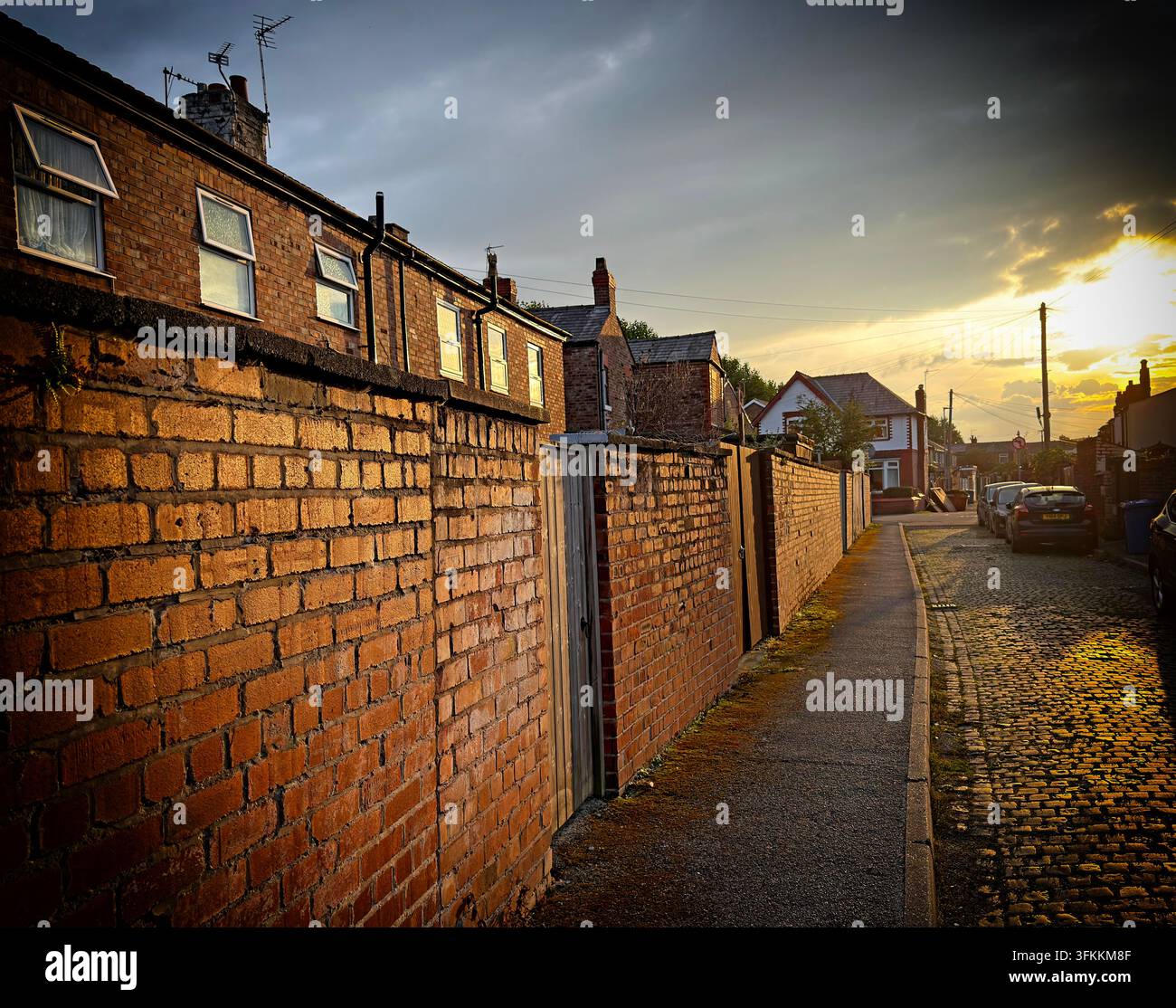
Ciel orageux sur les terrasses et les arrière-cours en briques rouges traditionnelles de Padgate, Warrington, contrastant les logements établis avec le défi des nouvelles constructions britanniques.
6086 x 4798 px | 51,5 x 40,6 cm | 20,3 x 16 inches | 300dpi
Date de la prise de vue:
22 septembre 2026
Lieu:
Padgate, Warrington, Cheshire, England, United Kingdom
Informations supplémentaires:
. Narrow brick alley behind traditional terraced housing in Padgate, Warrington, at sunset. A narrow rear passage runs between old brick walls and the backs of terraced houses in Padgate, Warrington, catching warm low sunlight beneath a darkening northern sky. The scene records a characteristic piece of working-class urban form found across industrial towns in North West England, where dense nineteenth- and early-twentieth-century terraces were built close to factories, railways and expanding town centres. Back alleys remain practical service spaces for bins, access and utilities but also carry strong visual associations with industrial heritage, housing conditions and long-established neighbourhoods. Weathered brickwork, walls and rear extensions give the photograph a deliberately ordinary documentary quality rather than a polished property view. Narrow rear alleys traditionally provide access for bins, bicycles, maintenance and utility work, while boundary walls and extensions reveal decades of alteration by successive occupants. In places such as Padgate, this pattern grew with dense terraced and small suburban development where back plots had to share limited service space. The low evening light turns the brickwork, rough surfaces and long perspective into a strong visual record of a residential environment that is usually overlooked. Such alleys can also become part of debates about fly-tipping, lighting, anti-social behaviour, drainage, security and access for refuse collection, because responsibility may be split between householders, landlords and the local authority. At the same time, they are part of the historical grain of neighbourhoods and often survive even when front elevations are modernised. The photograph can therefore sit within housing, regeneration and local-history coverage while remaining grounded in the practical physical details of an ordinary Warrington back alley at sunset.