3164 x 4764 px | 26,8 x 40,3 cm | 10,5 x 15,9 inches | 300dpi
Date de la prise de vue:
2013
Informations supplémentaires:
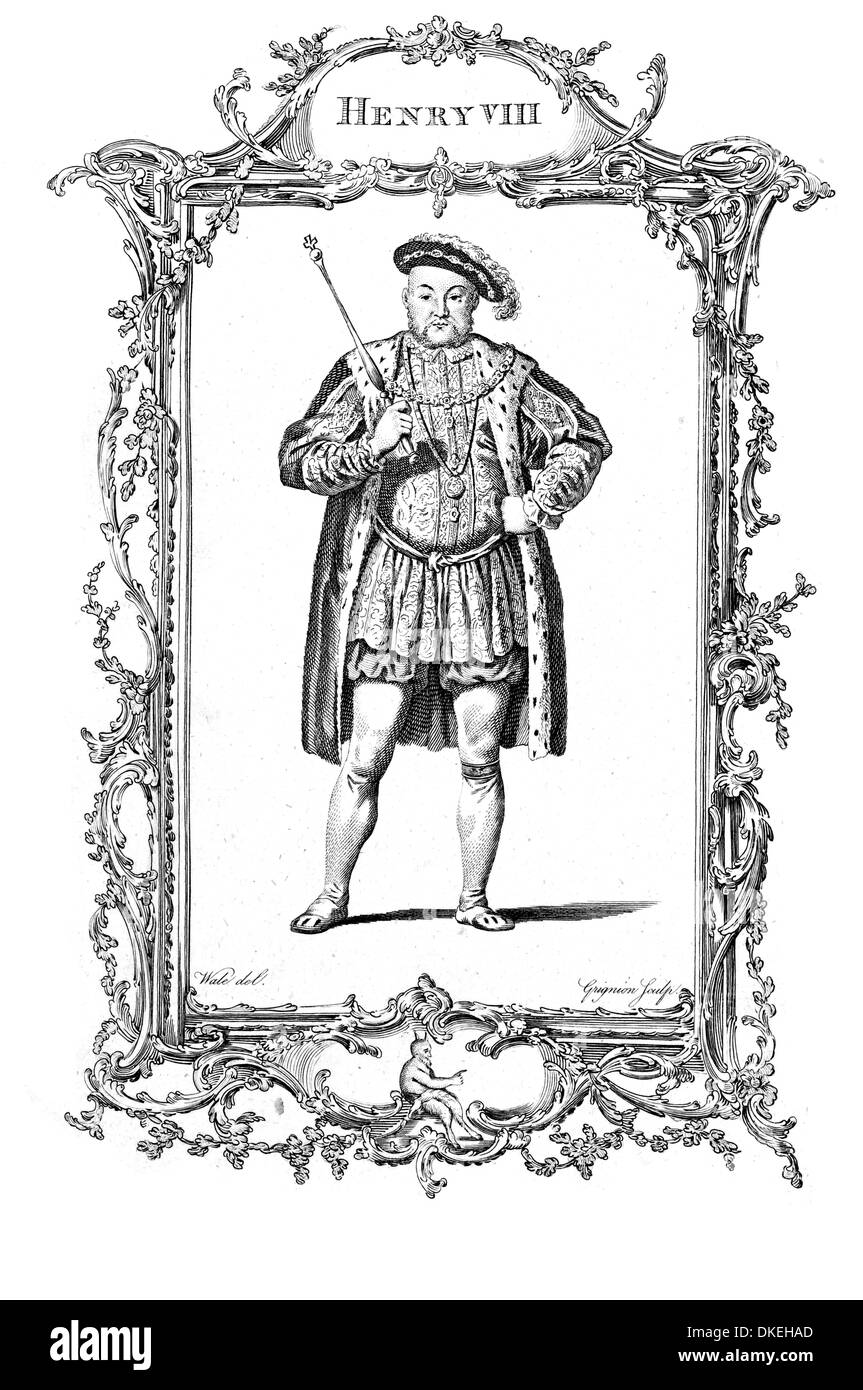
This illustration has been copied from an original Copper Plate engraving published in 1773 Henry VIII (28 June 1491 – 28 January 1547) was King of England from 21 April 1509 until his death. He was Lord, and later assumed the Kingship, of Ireland, as well as continuing the nominal claim by the English monarchs to the Kingdom of France. Henry was the second monarch of the Tudor dynasty, succeeding his father, Henry VII. Besides his six marriages, Henry VIII is known for his role in the separation of the Church of England from the Roman Catholic Church. Henry's struggles with Rome led to the separation of the Church of England from papal authority, the Dissolution of the Monasteries, and his own establishment as the Supreme Head of the Church of England. Yet he remained a believer in core Catholic theological teachings, even after his excommunication from the Roman Catholic Church. Henry oversaw the legal union of England and Wales with the Laws in Wales Acts 1535 and 1542. In 1513, the new king allied with the Holy Roman Emperor, Maximillian I, and invaded France with a large, well-equipped army, but achieved little at a considerable financial cost. Maximillian, for his part, used the English invasion to his own ends, and this prejudiced England's ability to defeat the French. This foray would prove the start of an obsession for Henry, who invaded again in 1544. This time, Henry's forces captured the important city of Boulogne, but again the Holy Roman Emperor, Charles V, supported Henry only as long as he needed to and England, strained by the enormous cost of the war, ransomed the city back for peace. His contemporaries considered Henry in his prime to be an attractive, educated and accomplished king, and he has been described as "one of the most charismatic rulers to sit on the English throne" Besides ruling with considerable power, he also engaged himself as an author and composer.