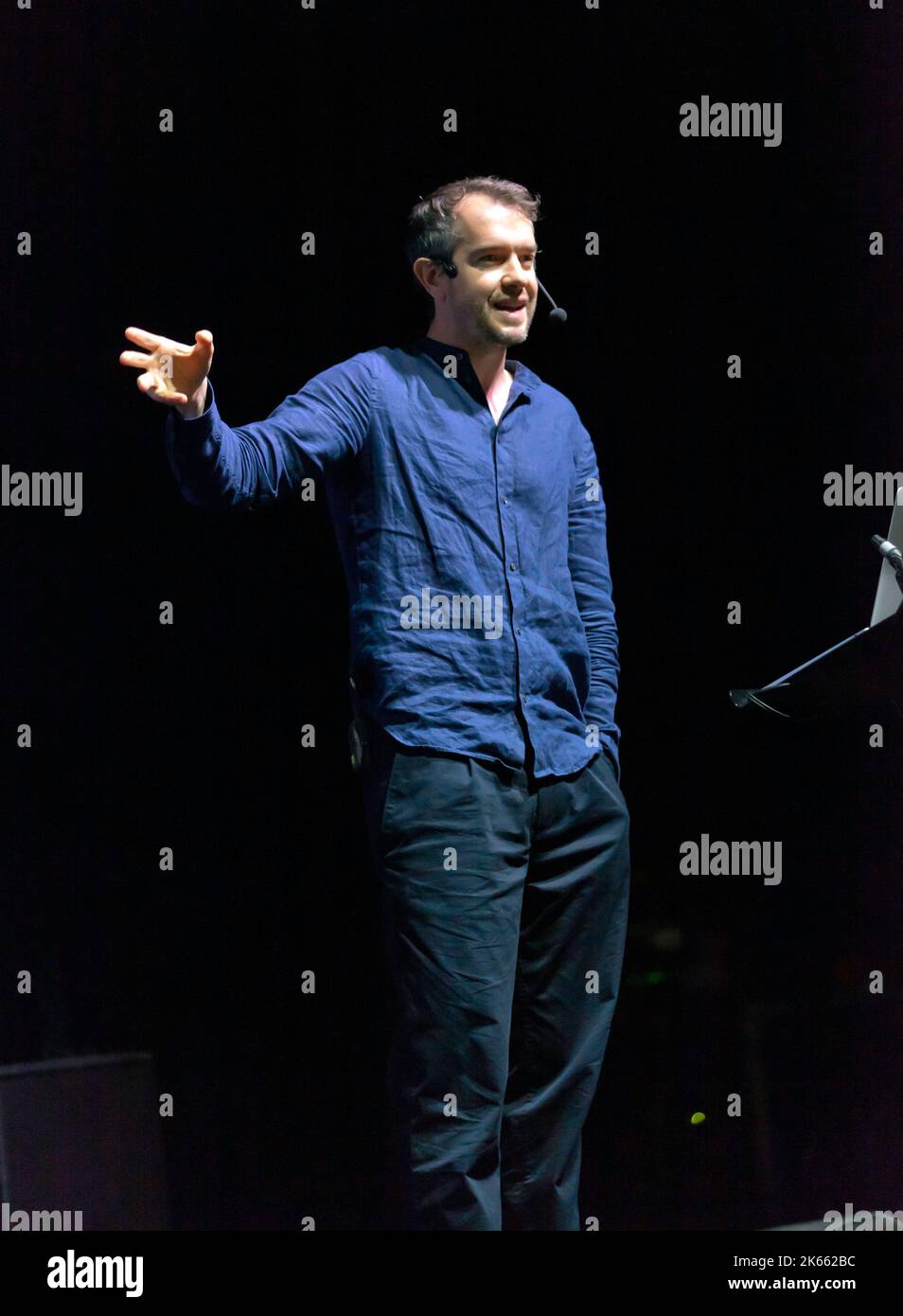
Le Dr Harry Cliff explique comment son travail avec le grand collisionneur de hadrons du CERN donne des indications sur une nouvelle force de la nature tirant sur les éléments fondamentaux de la matière.
3709 x 5054 px | 31,4 x 42,8 cm | 12,4 x 16,8 inches | 300dpi
Date de la prise de vue:
9 octobre 2022
Lieu:
ExCeL London, One Western Gateway, Royal Victoria Dock, London, E16 1XL
Informations supplémentaires:
Cette image peut avoir des imperfections car il s’agit d’une image historique ou de reportage.
Dr Harry Cliff is a particle physicist at the University of Cambridge working on the LHCb experiment, a huge particle detector buried 100 metres underground at CERN near Geneva. He is a member of an international team of around 1400 physicists, engineers and computer scientists who are using LHCb to study the basic building blocks of our universe, in search of answers to some of the biggest questions in modern physics. including the nature of dark matter and why the universe is made of matter and not antimatter. I study B-mesons, which are exotic particles containing a bottom quark. These particles are produced in huge numbers by the Large Hadron Collider and recorded in exquisite detail by the LHCb detector. I'm particularly interested in ultra-rare decays of these particles, which can be affected by new particles or forces that lie outside our current best theory, the Standard Model. By making precise measurements of these decays and comparing to what the Standard Model predicts, my colleagues and I hope to find the first signs of something altogether new.