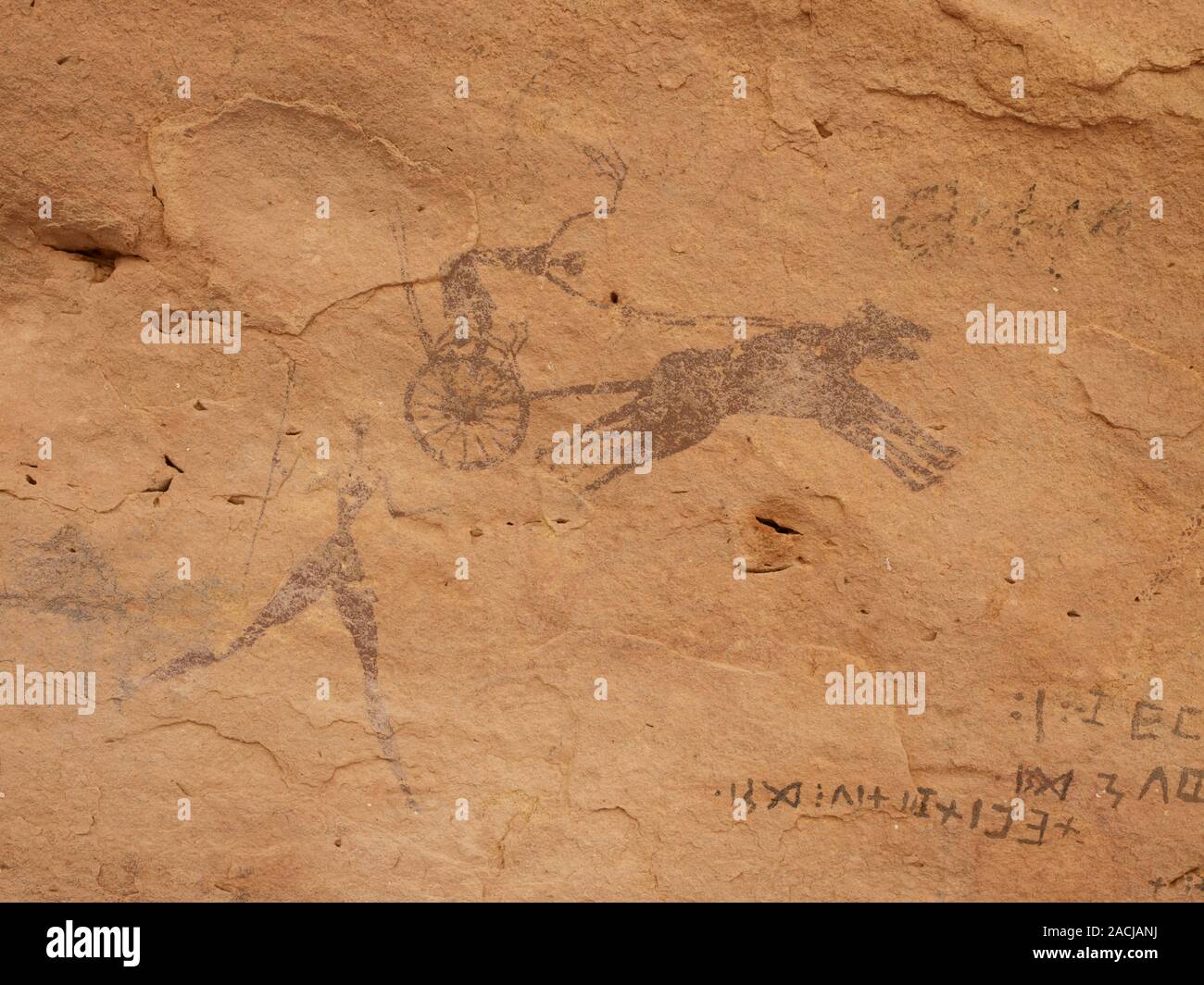
Le pictogramme d'un char avec 2 chevaux sur un cavewall Magidet proche à l'est de la Libye. Dans ses histoires (IV. 170) Hérodote déclare que le char était en
Pictograph of a chariot with 2 horses on a cavewall in eastern Libya near Magidet. In his Histories (IV. 170) Herodotus states that the chariot was invented in Libya. The prehistoric chariots preserved in cave art are much older than literary sources, between 5000 - 9000 years old and therefore the statements of Herodotus and others must have been based on popular culture current at the time. In all there are over 500 pictographs of such chariots, the later ones being usually associated with the Berber Garamantean culture of the Fezzan region of Libya (500BC - 700AD). The symbols at bottom right are examples of Proto-Tifinagh, or Libyco-Berber script. Derived from the Phoenician alphabet, it was in use between about the 3rd century BC and the 3rd century AD. The oldest petroglyphs are dated to approximately the Neolithic and late Upper Paleolithic boundary (10000 - 12000 years ago).