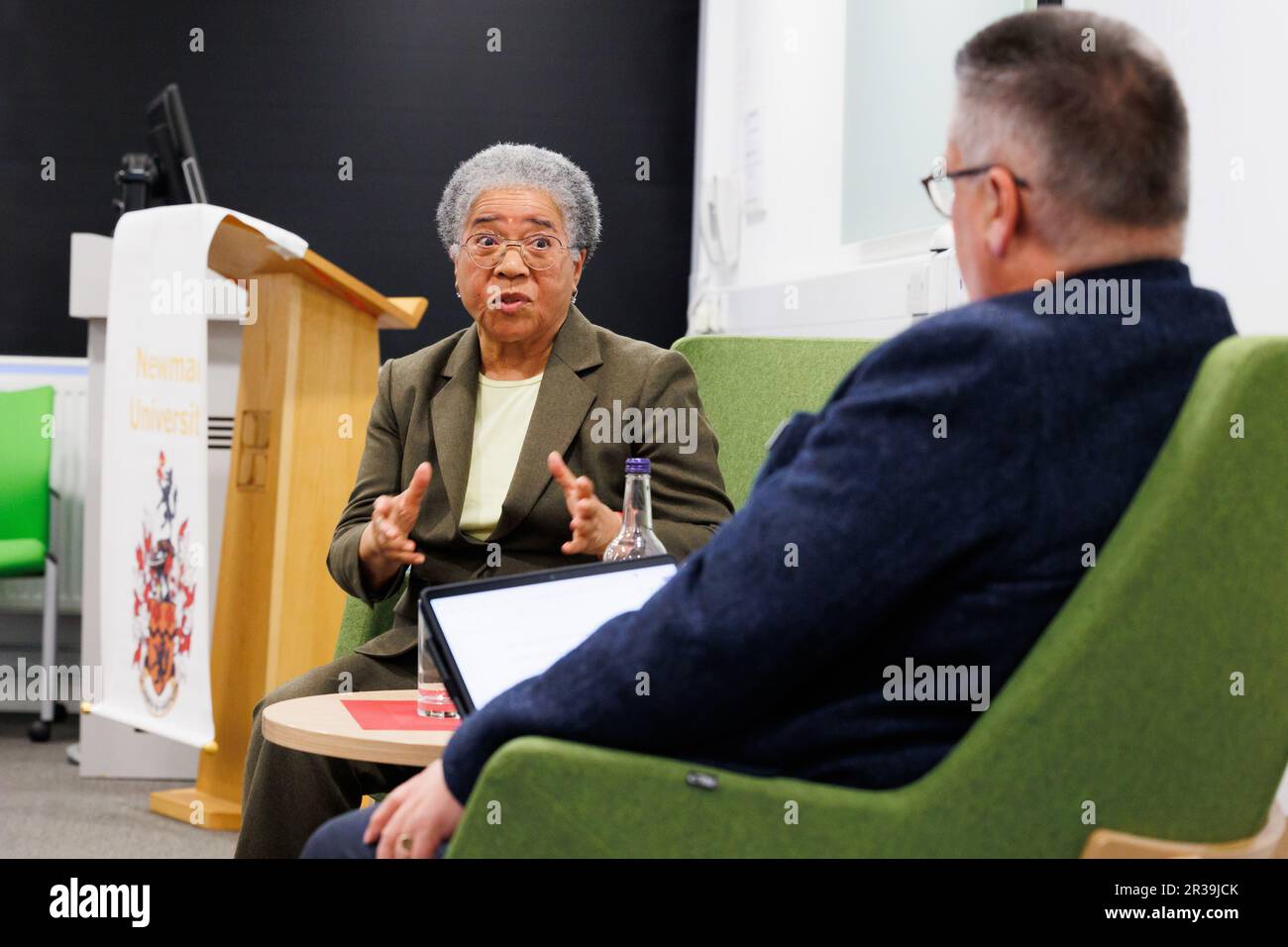
Le professeur Dame Elizabeth Anionwu photographié à l'Université Newman, Birmingham, Royaume-Uni. Dame Anionwu a ouvert l'École des sciences infirmières et de la santé alliée et a donné une conférence / interview informelle aux étudiants et aux enseignants.
5472 x 3648 px | 46,3 x 30,9 cm | 18,2 x 12,2 inches | 300dpi
Date de la prise de vue:
28 février 2023
Lieu:
Bartley Green, Birmingham, England, UK
Informations supplémentaires:
Cette image peut avoir des imperfections car il s’agit d’une image historique ou de reportage.
Professor Dame Elizabeth Nneka Anionwu Elizabeth was inspired to become a nurse at the young age of four because, whilst she was in care, a ‘wonderful nursing nun’ treated her childhood eczema in an expert and sensitive manner. Born in Birmingham in 1947, she identifies herself as of Irish/Nigerian heritage and started work for the NHS as a school nurse assistant in Wolverhampton at the age of 16. From Sickle to Seacole Elizabeth put a substantial amount of her life into her work as a nurse, health visitor and tutor working with black and minority ethnic communities in London. ‘People from diverse cultures are not always valued and still sometimes just seen as problems, ’ she says. In 1979, she helped to establish in Brent the first nurse-led UK Sickle & Thalassaemia Screening and Counselling Centre. In 1988 she was awarded a PhD from the Institute of Education, University College London (UCL). From 1990-1997 she worked at the Institute of Child Health, UCL as a Lecturer then Senior Lecturer in Community Genetic Counselling. She has written extensively and is a co-author with Professor Karl Atkin of the book ‘The Politics of Sickle Cell & Thalassaemia’ published in 2001 by the Open University Press. Honoured for services to nursing Elizabeth was honoured with the Order of Merit in 2022 and a Damehood (DBE) in the 2017 Queen’s New Year’s Honours List for her services to nursing and the Mary Seacole Statue Appeal. The Queen’s Nursing Institute awarded her a Fellowship (FQNI) in October 2017. In 2001 she was awarded a CBE for services to nursing. In 2004 she was presented with the Royal College of Nursing Fellowship (FRCN) for her work in the development of nurse-led sickle cell and thalassaemia counselling services and education and leadership in transcultural nursing.