
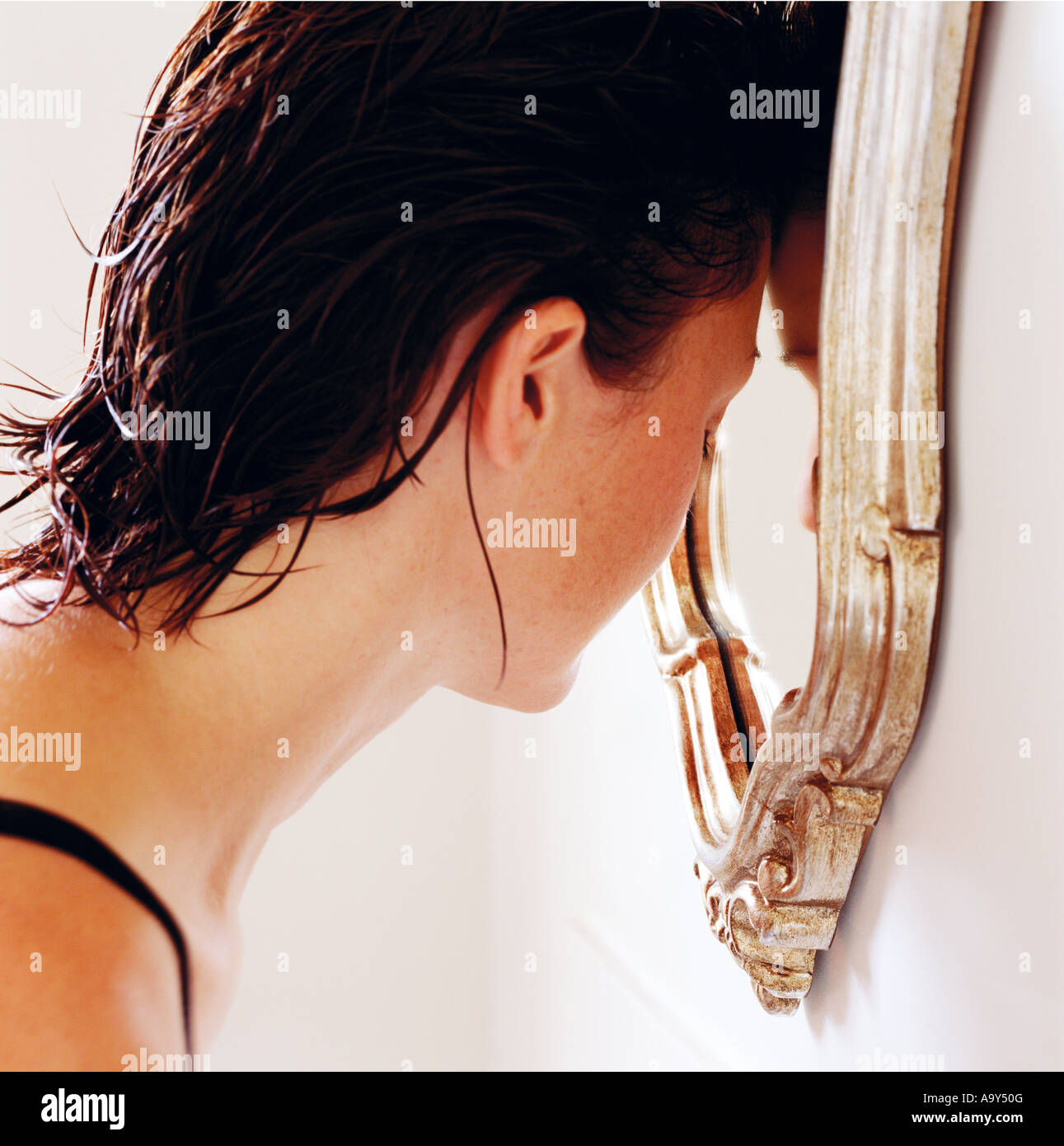
Fille et miroir
Détails de l'image
Contributeur:
Juliet BraunerID de l’image:
A9Y50GTaille du fichier:
79,8 MB (3,8 MB Téléchargement compressé)Autorisations:
Modèle - oui | Propriété - nonUne autorisation est-elle nécessaire?Dimensions:
5265 x 5300 px | 44,6 x 44,9 cm | 17,6 x 17,7 inches | 300dpiInformations supplémentaires:
A mirror is an object with a surface that has good specular reflection; that is, it is smooth enough to form an image. The most familiar type of mirror is the plane mirror, which has a flat surface. Curved mirrors are also used, to produce magnified or demagnified images or focus light. Mirrors are most commonly used for personal grooming, decoration, and architecture. Mirrors are also used in scientific apparatus such as telescopes and lasers, cameras, and industrial machinery. Most mirrors are designed for visible light, however, mirrors designed for other wavelengths of electromagnetic radiation are also used, especially in optical instruments. It is a common superstition that someone who breaks a mirror will receive seven years of bad luck. In Greek mythology, the hero Perseus killed Medusa by using a mirrored shield so as not to gaze upon her monstrous appearance (she turned anyone who looked at her to stone.) In English literature, a famous example is Lewis Carroll's Through the Looking Glass, in which protagonist Alice uses a mirror as a portal to a strange alternate world. A common use is that of scrying with a mirror. In Canterbury Tales, "The Squire's Tale" describes a magical mirror that can look over a king's realm; similarly, in The Faerie Queene, Merlin enchants a mirror to have this power.[5] Another example, from the German tales of the brothers Grimm, is Snow White, in which the Wicked Queen consults a magic mirror to determine the identity of the most beautiful woman in the world; this mirror is capable of scrying the forest and finding Snow White. In modern fantasy, the mirror of Galadriel, in J.R.R. Tolkien's fictional universe of Middle-earth, shows things that were, and things that are, and things that yet may be. Tennyson's Lady of Shalott has a mirror which shatters, releasing a curse on her. Mirrors, along with labyrinths, figure prominently in the work of Argentine writer Jorge Luis Borges, who often used them as symbols of infinity,

