3600 x 5400 px | 30,5 x 45,7 cm | 12 x 18 inches | 300dpi
Date de la prise de vue:
16 mai 2010
Lieu:
Chicago Botanic Garden, 1000 Lake Cook Road, Glencoe, IL 60022
Informations supplémentaires:
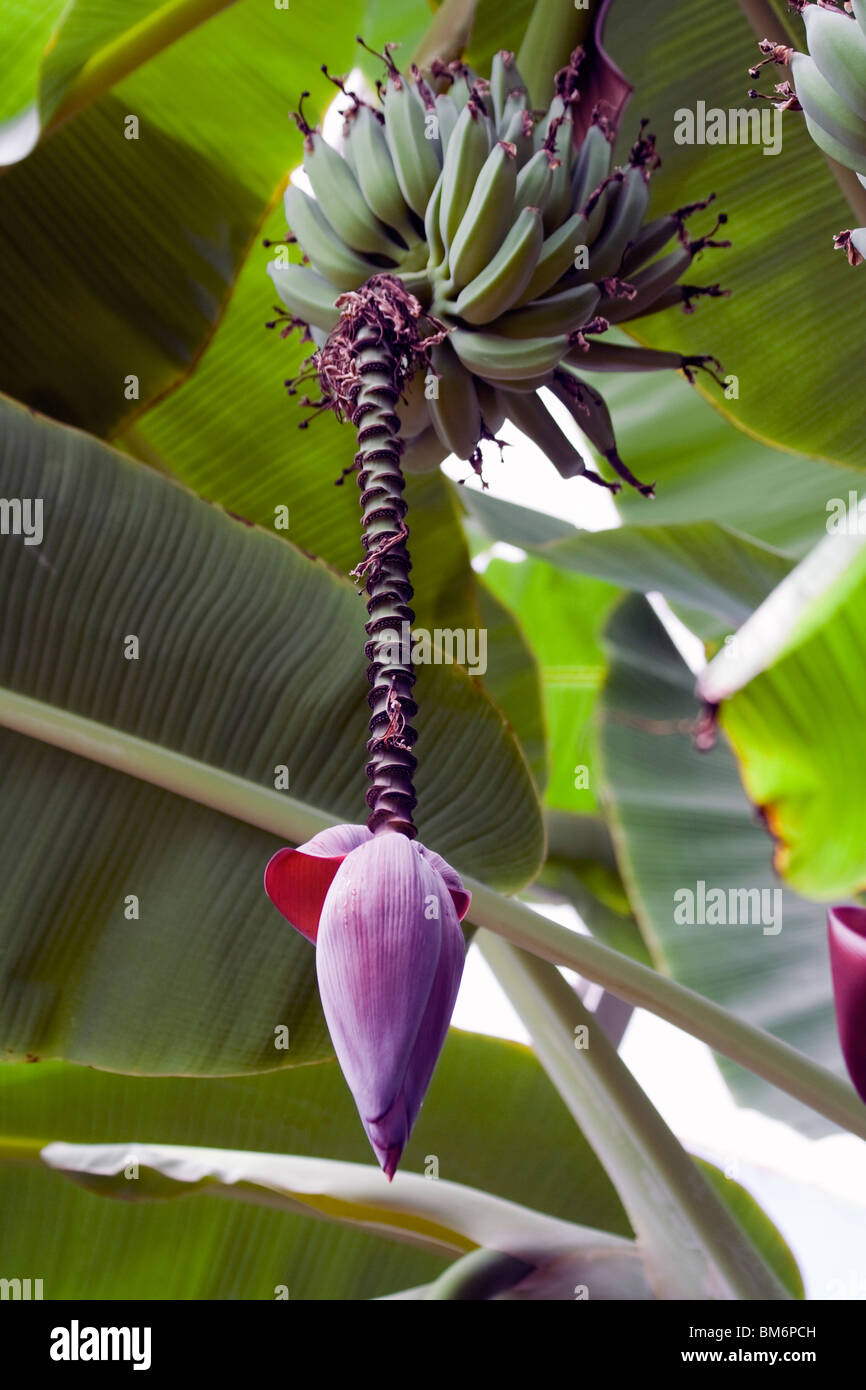
The banana plant is the largest herbaceous flowering plant.[4]. Plants are normally tall and fairly sturdy and are often mistaken for trees, but their main or upright stem is actually a pseudostem that grows 6 to 7.6 metres (20 to 24.9 ft) tall, growing from a corm. Each pseudostem can produce a single bunch of bananas. After fruiting, the pseudostem dies. Leaves are spirally arranged and may grow 2.7 metres (8.9 ft) long and 60 cm (2.0 ft) wide.[5] They are easily torn by the wind, resulting in the familiar frond look.[6] Banana fruit grow in hanging clusters, with up to 20 fruit to a tier (called a hand). The assemblage of hanging clusters is known as a bunch, comprising 3–20 tiers, or commercially as a "banana stem", and can weigh from 30–50 kilograms (66–110 lb). In common usage, bunch applies to part of a tier containing 3-10 adjacent fruits. Individual fruits average 125 grams (0.28 lb), of which approximately 75% is water and 25% dry matter. Each individual fruit (commonly known as a banana or 'finger') has a protective outer layer (a peel or skin) with an edible inner portion. The fruit typically has numerous long, thin strings (called phloem bundles), which run lengthwise between the skin and inner part. The inner part of the common yellow dessert variety splits easily lengthwise into three strips. Each stem normally produces a single, sterile, male banana flower, also known as the banana heart—though more can be produced; a single plant in the Philippines has five.[7] Banana hearts are used as a vegetable in Southeast Asia, steamed, in salads, or eaten raw.[8] The female flowers appear further up the stem, and produce the actual fruit without fertilization. The fruit has been described as a "leathery berry".[9] In cultivated varieties, the seeds are diminished nearly to non-existence; their remnants are tiny black specks in the interior of the fruit. The ovary is inferior to the flower; because of stiff stems and the positioning of the ovary and flower