3720 x 4520 px | 31,5 x 38,3 cm | 12,4 x 15,1 inches | 300dpi
Date de la prise de vue:
6 mai 2000
Lieu:
USA
Informations supplémentaires:
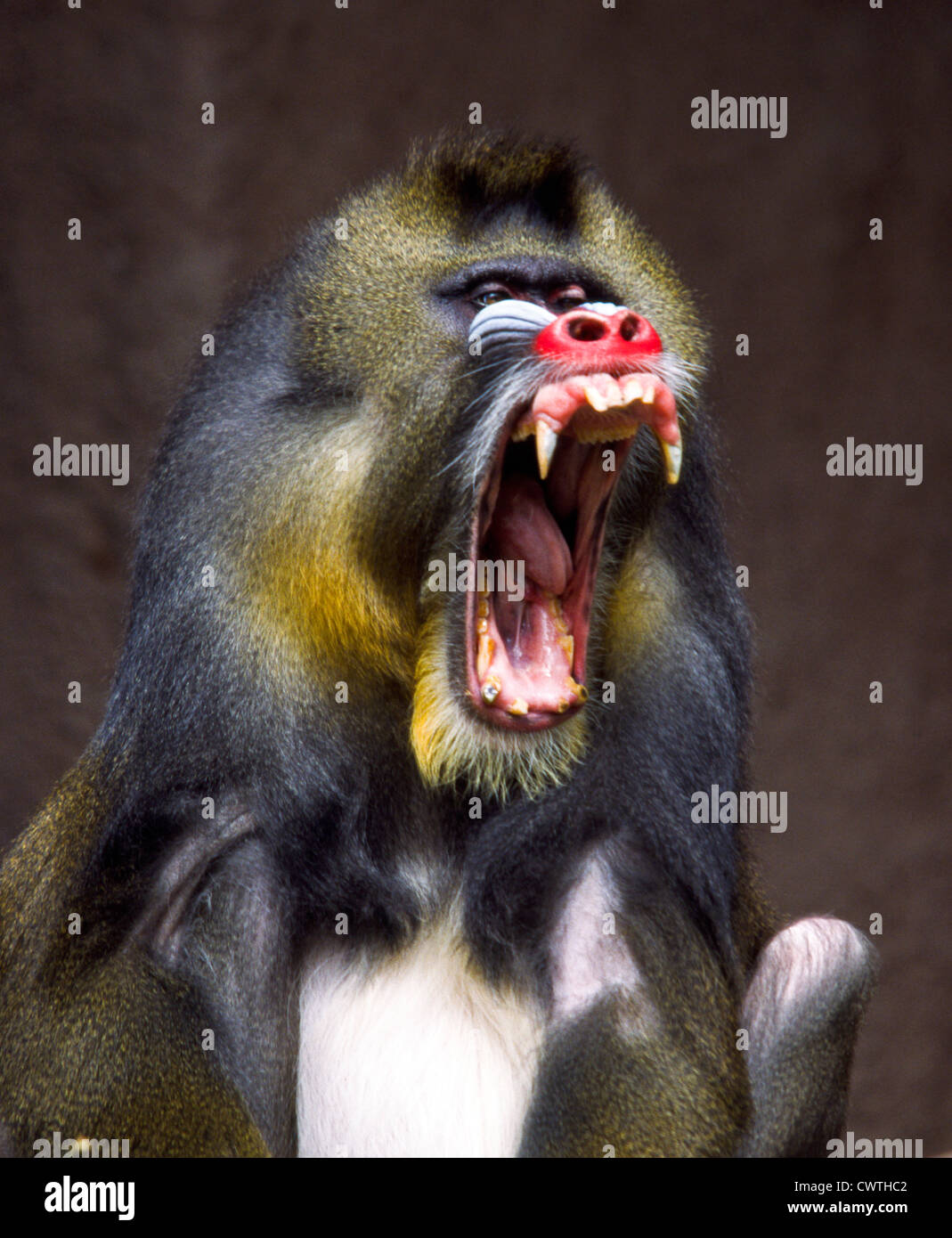
The mandrill is perhaps the most colorful primate. It has an olive green or dark grey pelage with yellow and black bands and a white belly. Its hairless face has an elongated muzzle with distinctive characteristics such as a red stripe down the middle and protruding blue ridges on the sides. It also has red nostrils and lips, a yellow beard and white tuffs. The areas around the genitals and the anus are multi-colored, being colored red, pink, blue, scarlet, and purple.[5] They also have pale pink ischial callosities.[5] The coloration of the animal is more pronounced in dominant adult males. Both sexes have chest glands which used in olfactory communication. These, too, are more prominent in dominant adult males.[6] Males also have longer canines than females, with an average of 4.5 cm (1.8 in) and 1.0 cm, respectively.[7] The mandrill is an omnivore. It usually consumes plants and eats over a hundred species. It prefers to eat fruits, but will also eat leaves, lianas, bark, stems, and fibers. It also consumes mushrooms and soil.[19] With animals, mandrills mostly eat invertebrates, particularly ants, beetles, termites, crickets, spiders, snails, and scorpions. It will also eat eggs, or even vertebrates such as birds, tortoises, frogs, porcupines, rats, and shrews.[19] Mandrills likely will eat larger vertebrates when they get the opportunity, such as juvenile bay duikers and other small antelope. Large prey are likely killed with a bite to the nape with the mandrill's long canines.[22] One study found the Mandrill's diet was composed of fruit (50.7%), seeds (26.0%), leaves (8.2%), pith (6.8%), flowers (2.7%), and animal foods (4.1%), with other foods making up the remaining (1.4%).[2