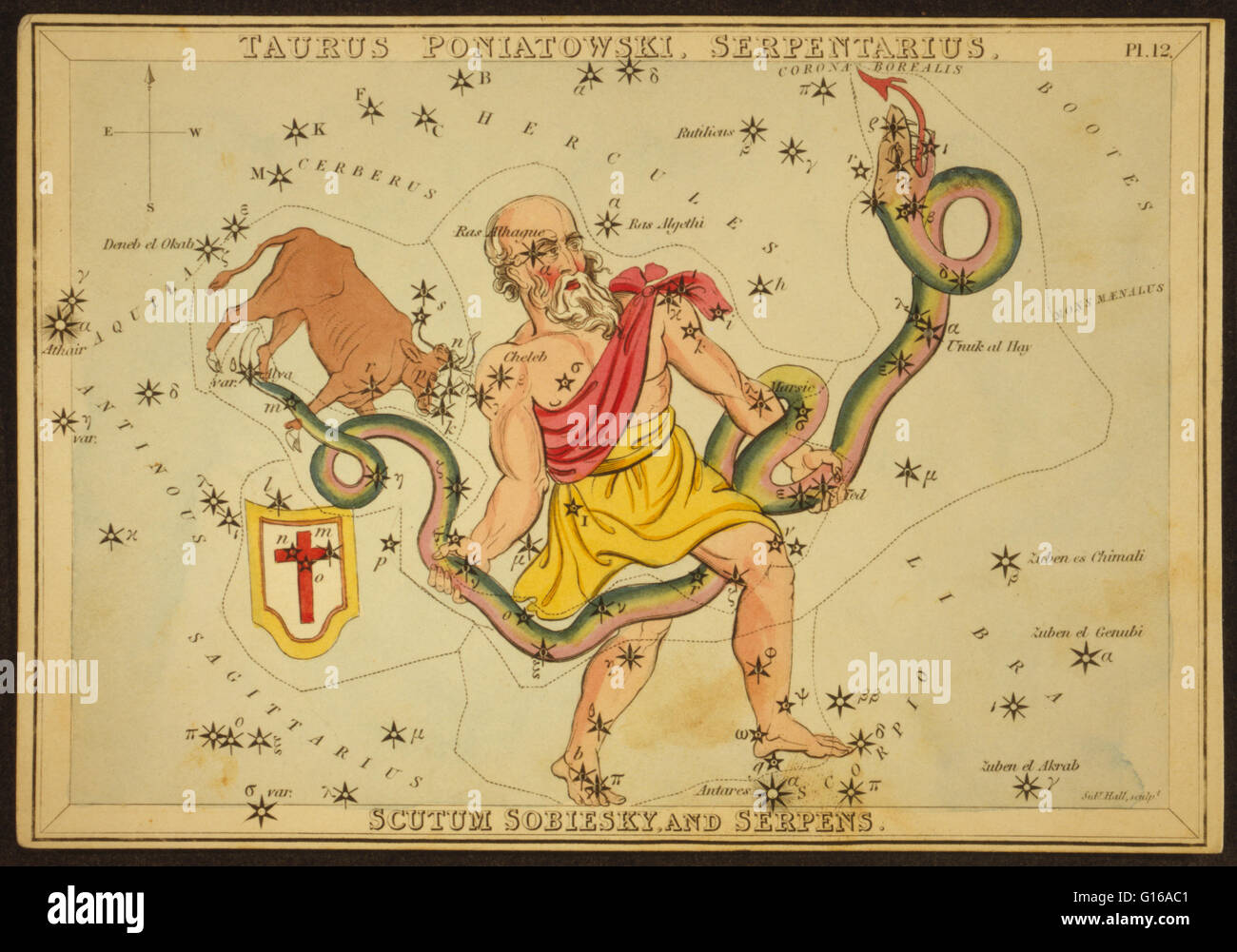
Tableau astronomique montrant un homme aux prises avec un serpent, à la fin de laquelle est un taureau et un bouclier portant une croix formant les constellations. Ophiuchus est une grande constellation situé autour de l'équateur céleste. Il a été anciennement dénommé
Cette image peut avoir des imperfections car il s’agit d’une image historique ou de reportage.
Astronomical chart showing a man grappling with a serpent, at the tail end of which is a bull and a shield bearing a cross forming the constellations. Ophiuchus is a large constellation located around the celestial equator. It was formerly referred to as Serpentarius. It is commonly represented as a man grasping the snake that is represented by the constellation Serpens. Serpens is unique among the modern constellations in being split into two non-contiguous parts, Serpens Caput (Serpent's Head) to the west and Serpens Cauda (Serpent's Tail) to the east. They were two of the 48 constellations listed by the 2nd century astronomer Ptolemy and they remain two of the 88 modern constellations defined by the International Astronomical Union. Scutum is a small constellation introduced in the seventeenth century. Its name is Latin for shield. It was created in 1684 by Polish astronomer Johannes Hevelius, who originally named it Scutum Sobiescianum (Shield of Sobieski) to commemorate the victory of the Polish forces led by King John III Sobieski (Jan III Sobieski) in the Battle of Vienna in 1683. Later, the name was shortened to Scutum. Taurus Poniatovii was a constellation created by Marcin Odlanicki Poczobutt in 1777 to honor Stanislaus Poniatowski, king of Poland. It consisted of stars that are today considered part of Ophiuchus and Aquila. It is no longer in use. It was wedged in between Ophiuchus, Aquila and Serpens Cauda. Urania's Mirror is a boxed set of 32 constellation cards first published by Samuel Leigh of the Strand, London, in or shortly before 1825. An unidentified lady, referred to by her nom-de-plume, Jehoshaphat Aspin, designed these whimsical astronomy cards. The engraver was Sidney Hall.