4842 x 6020 px | 41 x 51 cm | 16,1 x 20,1 inches | 300dpi
Date de la prise de vue:
23 août 2026
Lieu:
R.A.O.B. Hall, 52 Witton Street, Northwich, Cheshire, England, UK
Informations supplémentaires:
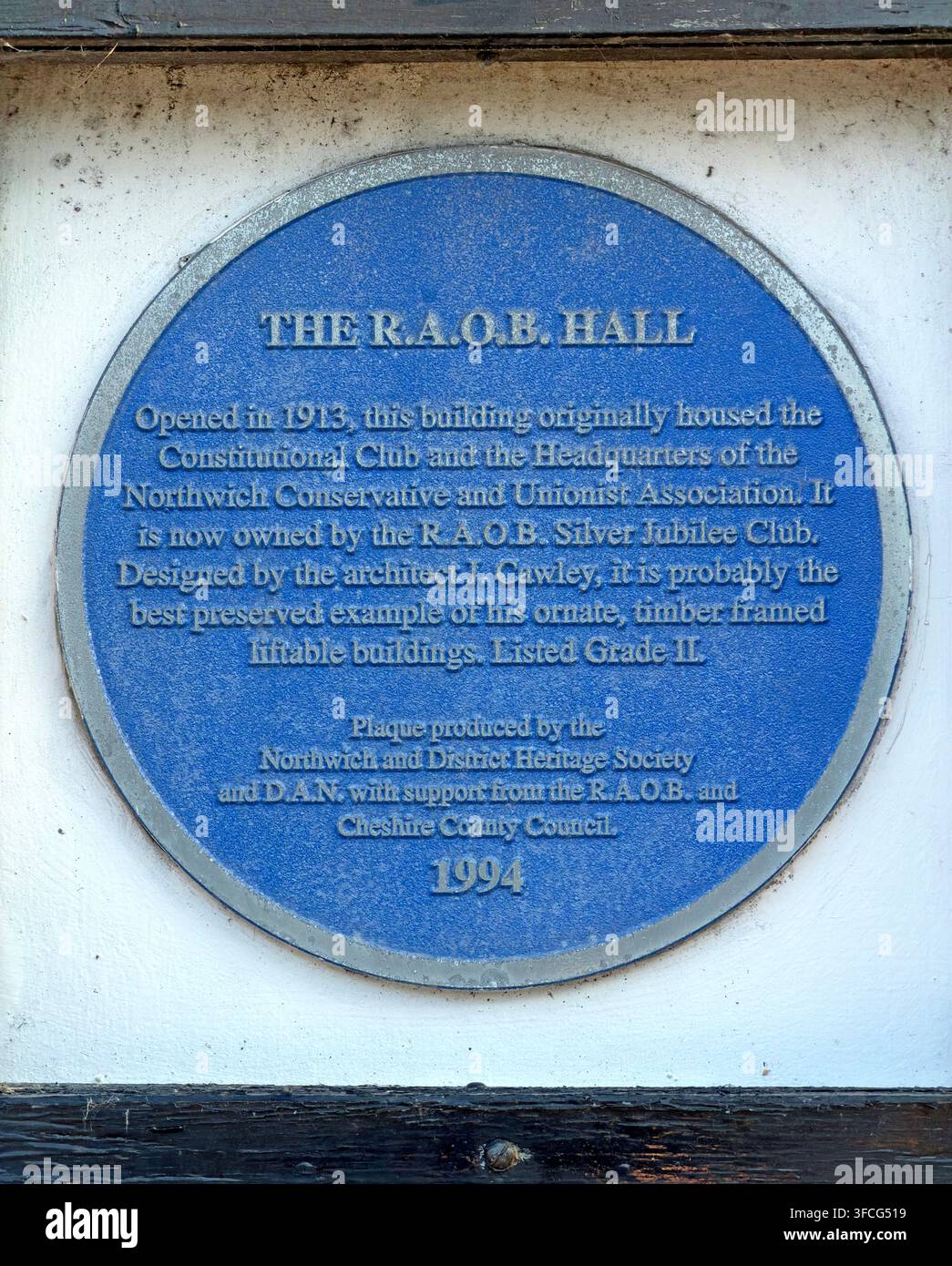
. The plaque commemorates J. Cawley, architect of the building now known as the R.A.O.B. Hall at 52 Witton Street, Northwich. Historic England lists the building at Grade II and records that it was built in 1911 as a Constitutional Club before later use by the Royal Antediluvian Order of Buffaloes. Its construction is especially characteristic of Northwich: the timber-framed structure was designed to be 'liftable', allowing it to be jacked and levelled in response to the ground subsidence historically caused by brine extraction and salt mining beneath the town. Decorative details include plaster panels, a jettied gable, balcony and rounded oriel windows. Northwich's distinctive liftable buildings form an important architectural response to an industrial-geological problem, and surviving examples help explain how the salt industry literally shaped the town above ground. The plaque and hall therefore connect local architecture, fraternal organisations, conservation and the extraordinary engineering history of Cheshire's salt district. The image is also suited to retrospective use because branding, street furniture and commercial occupation can change with little warning. Relevant search and editorial concepts include Northwich, Mid Cheshire, Cheshire West and Chester, town centre, Witton Street, River Weaver, salt town, regeneration, local history, public realm, high street, community, Cheshire. Useful descriptive vocabulary for archive discovery includes Cawley, RAOB, Hall, Northwich, blue, plaque, Witton, Street, architect, Constitutional, Club, Grade, II, listed, timber, framed, liftable, subsidence, Cheshire, heritage. Its value is strongest when used with precise place and date information, making it relevant to archives, newspapers, magazines, books, planning material and online features about contemporary Britain. The photograph is suitable for editorial, documentary, social-history, planning,