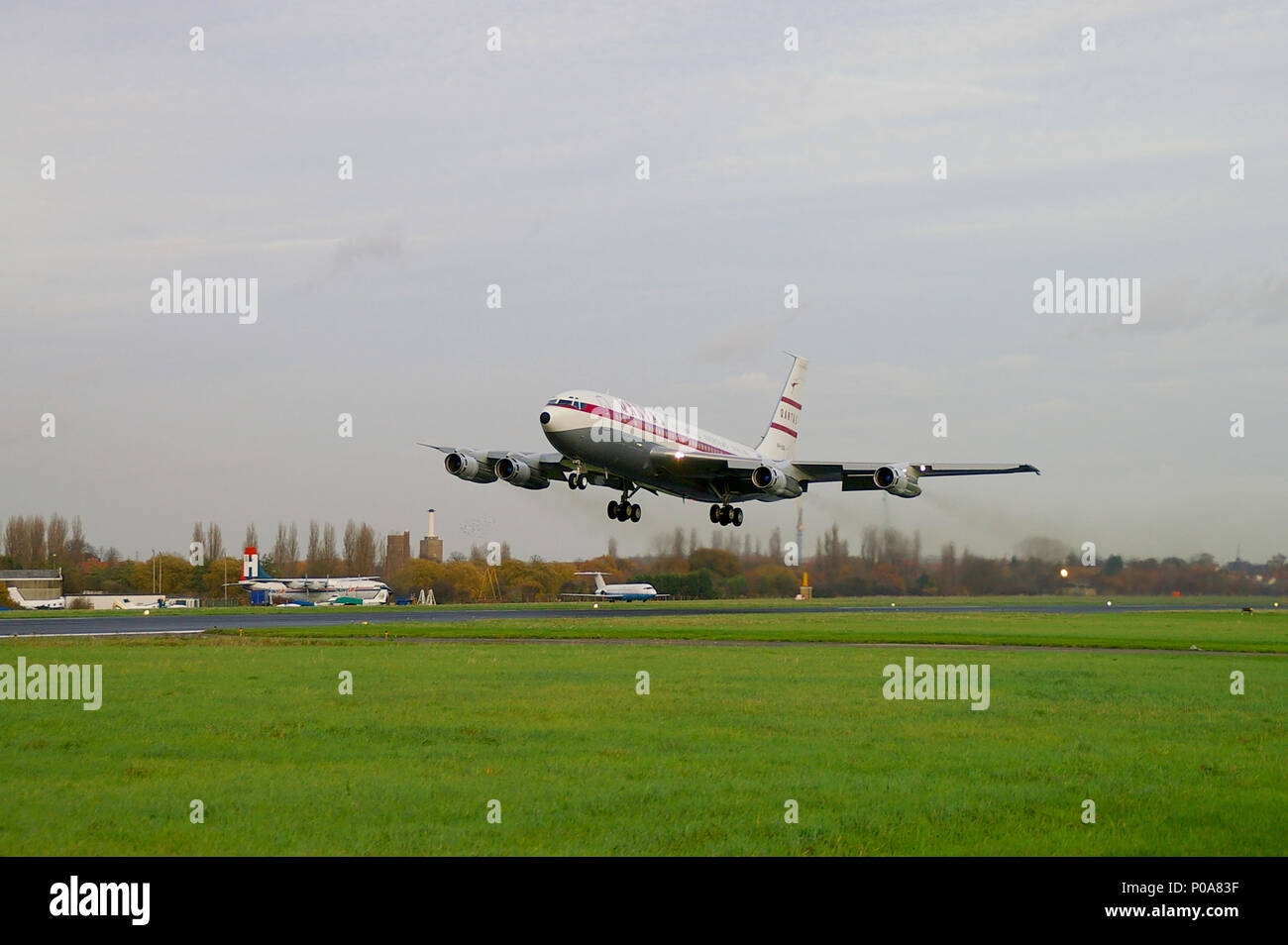
QANTAS Boeing 707 VH-XBA (anciennement VH-EBA) qui fut le premier avion de ligne à réaction de la compagnie aérienne, décollant de l'aéroport de Southend après restauration. Volé 1959
3200 x 2128 px | 27,1 x 18 cm | 10,7 x 7,1 inches | 300dpi
Date de la prise de vue:
2 décembre 2006
Lieu:
London Southend Airport (SEN), Southend-on-Sea, UK
Informations supplémentaires:
When VH-EBA was handed over to Qantas in a ceremony on July 2nd 1959, it was the first Boeing 707 delivered to a non-US customer. That made it the first civilian jet to wear an Australian registration (on June 7th 1959) but it wouldn’t leave Seattle until the 17th because Boeing used it to develop the fifth pod spare engine carrying system. Qantas, a government-owned airline, used the name ‘City of Canberra’ for aircraft doing first events because that aircraft would have the most publicity. As the first ‘handed over’, VH-EBA wore ‘City of Canberra’ under the flight deck during the ceremony. The name then transferred to VH-EBB which was the first to fly to Australia, departing Seattle on its delivery flight on June 30th and arriving in Sydney on July 2nd. VH-EBA became ‘City of Melbourne’, a name it wore throughout its career with Qantas. Incidentally, VH-EBC did the first scheduled Qantas 707 service on July 29th so became the long-term bearer of the ‘City of Canberra’ name. VH-EBB spent its Qantas life as ‘City of Sydney’. VH-EBA was the first Qantas 707 to be completed and the first of only thirteen produced to a Qantas specification with a fuselage which was three metres shorter than the normal 100-series 707 to make it viable on the Pacific Ocean route. It had less weight but carried the same fuel. What made the museum’s 707 special was not just the dramatic impacts it had on air travel but on Australian society as a whole.After serving with Qantas, the aircraft was operated by other airlines and private operators. After several years lying derelict at Southend Airport in the United Kingdom and about to be scrapped, it was purchased by Qantas Founders Museum and restored and flown to Longreach in June 2007 by a dedicated group of volunteers, mostly retired Qantas engineers.