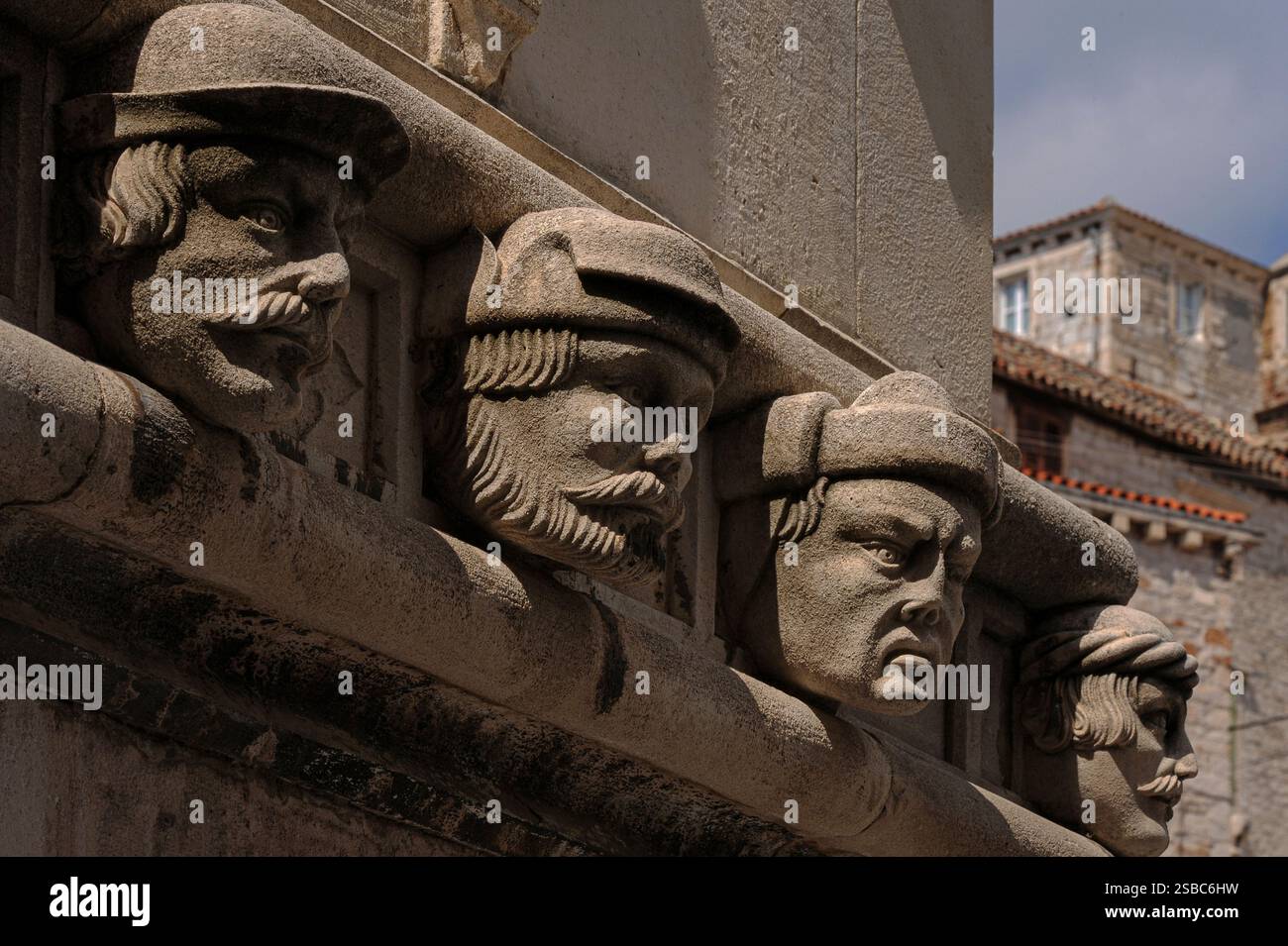
Quatre visages du XVe siècle : des hommes de la Renaissance, trois avec des moustaches, représentés dans une frise sculpturale courant autour des trois absides de la cathédrale Saint-Jacques à Šibenik, Dalmatie, Croatie. Il présente 71 têtes grandeur nature sculptées par le sculpteur vénitien et architecte du XVe siècle Giorgio da Sebenico ou Georgius Mathei Dalmaticus - peut-être toutes les personnes qu'il connaissait.
4256 x 2832 px | 36 x 24 cm | 14,2 x 9,4 inches | 300dpi
Date de la prise de vue:
4 septembre 2007
Lieu:
Cathedral of Saint James, Šibenik, Šibenik-Knin County, Dalmatia, Croatia
Informations supplémentaires:
Cette image peut avoir des imperfections car il s’agit d’une image historique ou de reportage.
Šibenik, Dalmatia, Croatia: four Renaissance men, all wearing hats and three with moustaches, stare out from a sculptural frieze running around the three apses of the Roman Catholic Cathedral of Saint James. The four finely-sculpted heads are among 71 carved by Venetian sculptor and master architect Giorgio da Sebenico (c.1410 - 1473), who spent more than three decades blending the cathedral’s structure and decoration into a prime example of Gothic-Renaissance architecture. The cathedral was his life’s work, but he did not live to see his masterpiece completed. The portraits are anonymous, but are believed to be depictions of 15th century people that Giorgio knew, including some of his fellow cathedral builders and artists. Giorgio, also known as Georgius Mathei Dalmaticus, Juraj Matejev Dalmatinac and George the Dalmatian, worked on the cathedral from 1441 until his death, from 1443 as its master architect. He was a leading exponent of the Gothic form, but was also open to Renaissance principles, effectively founding a movement in Dalmatia combining the two styles. From 1475 to 1505, the celebrated Italian sculptor and architect Niccolò di Giovanni Fiorentino (1418 - 1505), also known as Nicholas of Florence, took over as master architect. He further transformed the triple-aisled basilica in the Tuscan Renaissance style. As the cathedral was not finished until 1535 and not consecrated until 1555, Niccolò also never saw the conclusion of his work. The cathedral, topped by a graceful dome or cupola, was built entirely of stone using unique construction techniques. It is now seen as the most important Renaissance building in Croatia, gaining UNESCO World Heritage Site status in 2000. Šibenik, historically named Sebenico, was owned from 1412 by the Venetian Republic. Apart from the cathedral and a ducal palace, it features four fortresses and other defences including walls, ramparts, gateways and a pentagonal tower. D1138.B3587