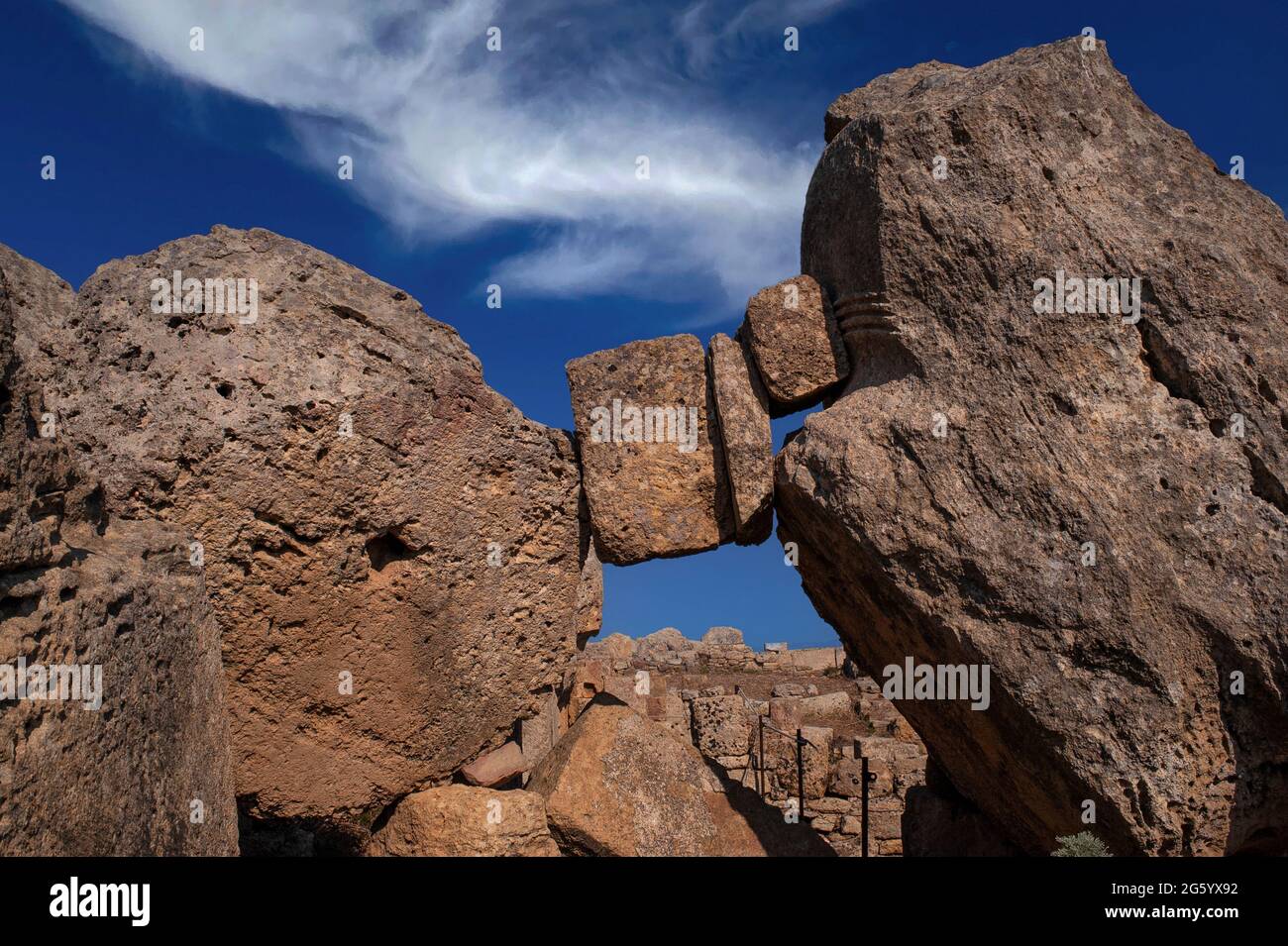
Suspendus dans l'espace et le temps au parc archéologique de Selinunte en Sicile, Italie : des morceaux de maçonnerie grecque antique piégés où ils sont tombés entre un tambour à colonne inachevé et un capital dorique partiellement taillé dans la roche solide. Partie d'un temple effondré construit il y a environ 2 500 ans pour la colonie grecque antique de Sélinus ou Sélinous.
4256 x 2832 px | 36 x 24 cm | 14,2 x 9,4 inches | 300dpi
Date de la prise de vue:
21 août 2011
Lieu:
Selinunte, Sicily, Italy
Informations supplémentaires:
Cette image peut avoir des imperfections car il s’agit d’une image historique ou de reportage.
Selinunte, Sicily, Italy: hanging in space and time … chunks of Ancient Greek masonry trapped where they fell between an unfinished column drum and a Doric capital part-cut from solid rock. They lie amid the ruins of a collapsed Doric temple, built around 2, 500 years ago for the Ancient Greek trading colony of Selinus or Selinous. The temple, founded in 530 BC and dedicated to either Apollo or Zeus, is now known as Temple G and its ruins lie in a 570-hectare Archaeological Park at Selinunte. Temple G was still unfinished, with many columns left un-fluted, when Selinus was sacked by Carthage in 409 BC. Like other Selinus temples, it probably collapsed in medieval earthquakes – centuries after the Ancient Greek city was abandoned. The temple was, at 113m long, 54m wide and 30m high (371 x 177 x 98 ft), the second largest Ancient Greek temple in Sicily. It had eight massive columns at the front, eight at the rear and 17 down each side. Each column was over 16m (53 ft) high, with a base diameter of 3.4m (11 ft). Selinus was founded in 651 or 628 BC by Greek colonists, perhaps taking its name from wild celery (Greek: selinon) flourishing on the clifftop site. Selinus became prosperous, but border disputes with the rival city of Segesta and a subsequent alliance with Syracuse against Carthage provoked its downfall. In 409 BC, a 100, 000-strong Carthaginian army mounted a 10-day siege, which ended with the city walls razed, many buildings destroyed, 16, 000 citizens dead and 5, 000 more taken prisoner. Only 2, 600 people escaped. A later revival ended in 250 BC when Carthage moved the city’s inhabitants elsewhere. D1109.B3241.A