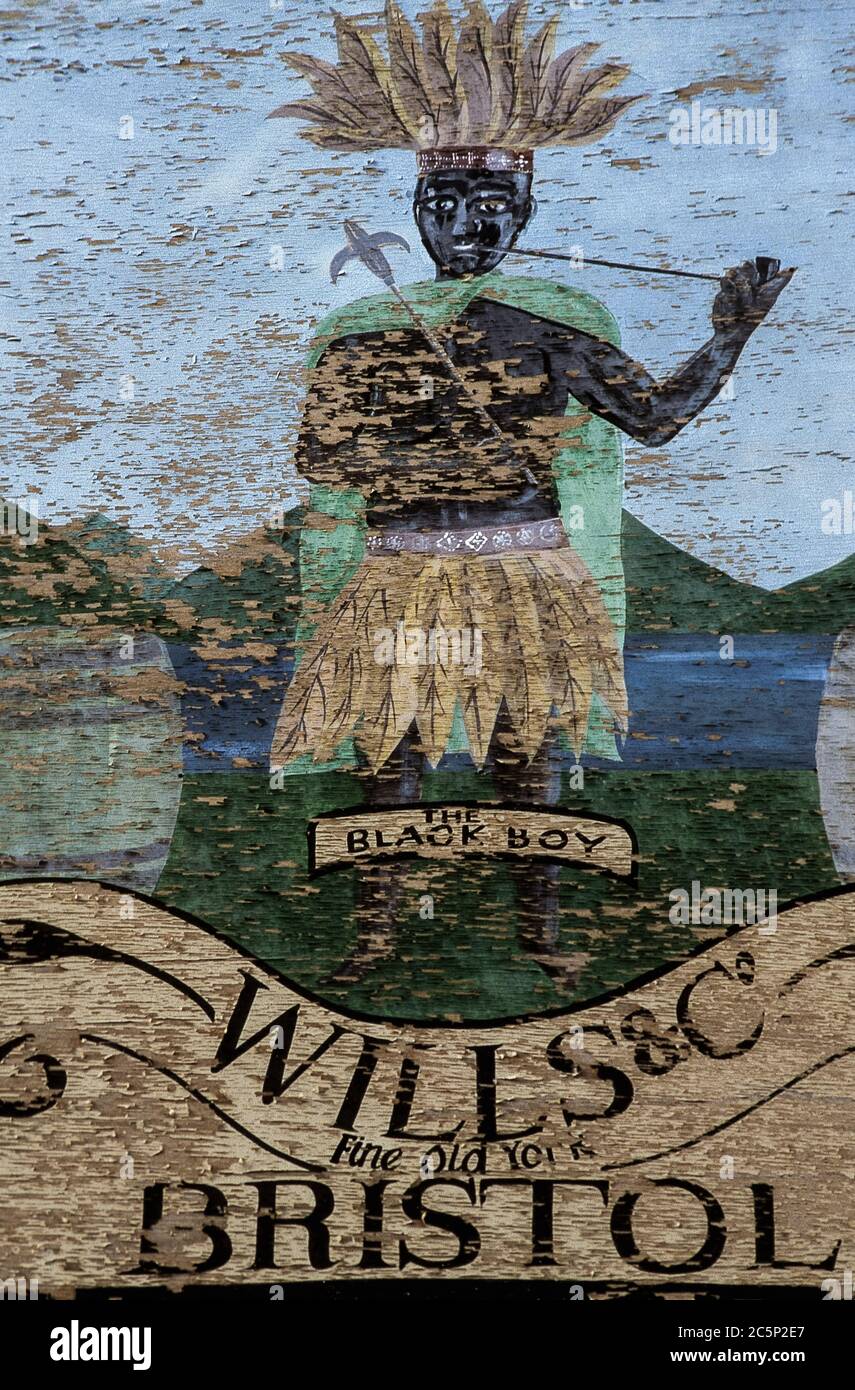
« The Black Boy » : une publicité vintage écaillée pour les marchands de tabac, Wills and Co, peinte à la main sur un panneau de bois - raciste et profondément offensante pour les yeux modernes. Le garçon est montré fumant une pipe tout en portant un couvre-chef et une tunique ou une jupe en feuilles de tabac. Photographié en août 1999 sur la façade du tabaciste Marshall’s, également connu sous le nom de The Pipe Shop, au 6e Mary’s Street, Ely, Cambridgeshire, Angleterre. Marshall’s a fermé en 2006 et ce panneau vintage a depuis longtemps disparu.
3459 x 5254 px | 29,3 x 44,5 cm | 11,5 x 17,5 inches | 300dpi
Date de la prise de vue:
7 août 1999
Lieu:
Former Marshall's / The Pipe Shop, 6 St. Mary's Street, Ely, Cambridgeshire, England, UK
Informations supplémentaires:
Cette image peut avoir des imperfections car il s’agit d’une image historique ou de reportage.
Ely, Cambridgeshire, United Kingdom: ‘The Black Boy’ - this flaking and now deeply politically incorrect and racially offensive painting of a pipe-smoking BAME youngster, photographed on 35mm film in August 1999, once adorned the façade of the tobacconist Marshall’s, also known as The Pipe Shop, at 6 St. Mary’s Street. Marshall’s closed in 2006 when the owners retired. The premises has since been occupied by other businesses and both this painted panel and its companion, a Constable’s Virginia tobacco painting of a sailing ship, have long since vanished from the façade. ‘The Black Boy’ would once have promoted the products of the British tobacco importer and manufacturer Wills & Co. Henry Overton Wills and his business partner, Samuel Watkins, opened a tobacco shop in Castle Street, Bristol, in 1786. Wills, Watkins & Co became Wills & Co when Watkins retired in 1789. It only retained this title for two years, until 1791, when it merged with the firm of snuff mill owner Peter Lilly, and was then called Lilly and Wills. This advertisement may therefore date from the late 18th century, towards the end of Bristol’s heavy involvement in the transatlantic slave trade. Bristol merchants financed over 2, 000 slaving voyages from 1698 to 1807, with the ships carrying more than 500, 000 African slaves to plantations in the Americas. Although the Act for the Abolition of the Slave Trade became law in 1807, slavery itself persisted in British colonies until its final abolition in 1838. The company became W.D. & H.O. Wills in 1830 and in 1901 it was one of the founding companies of Imperial Tobacco. That name today survives as the multinational tobacco company Imperial Brands plc, headquartered in Bristol. Digital file produced from a scan of an image captured on 35mm film in August 1999. Camera: Nikon FM. Film stock: Fujichrome Provia 100 35mm colour transparency. Scanner: Nikon Super Coolscan 9000 ED. C0723.A6418