7172 x 7590 px | 60,7 x 64,3 cm | 23,9 x 25,3 inches | 300dpi
Date de la prise de vue:
1924
Informations supplémentaires:
Cette image appartient au domaine public, ce qui signifie que le droit d’auteur a expiré ou que le titulaire du droit d’auteur a renoncé à ses droits. Les frais facturés par Alamy couvrent l’accès à la copie haute résolution de l’image.
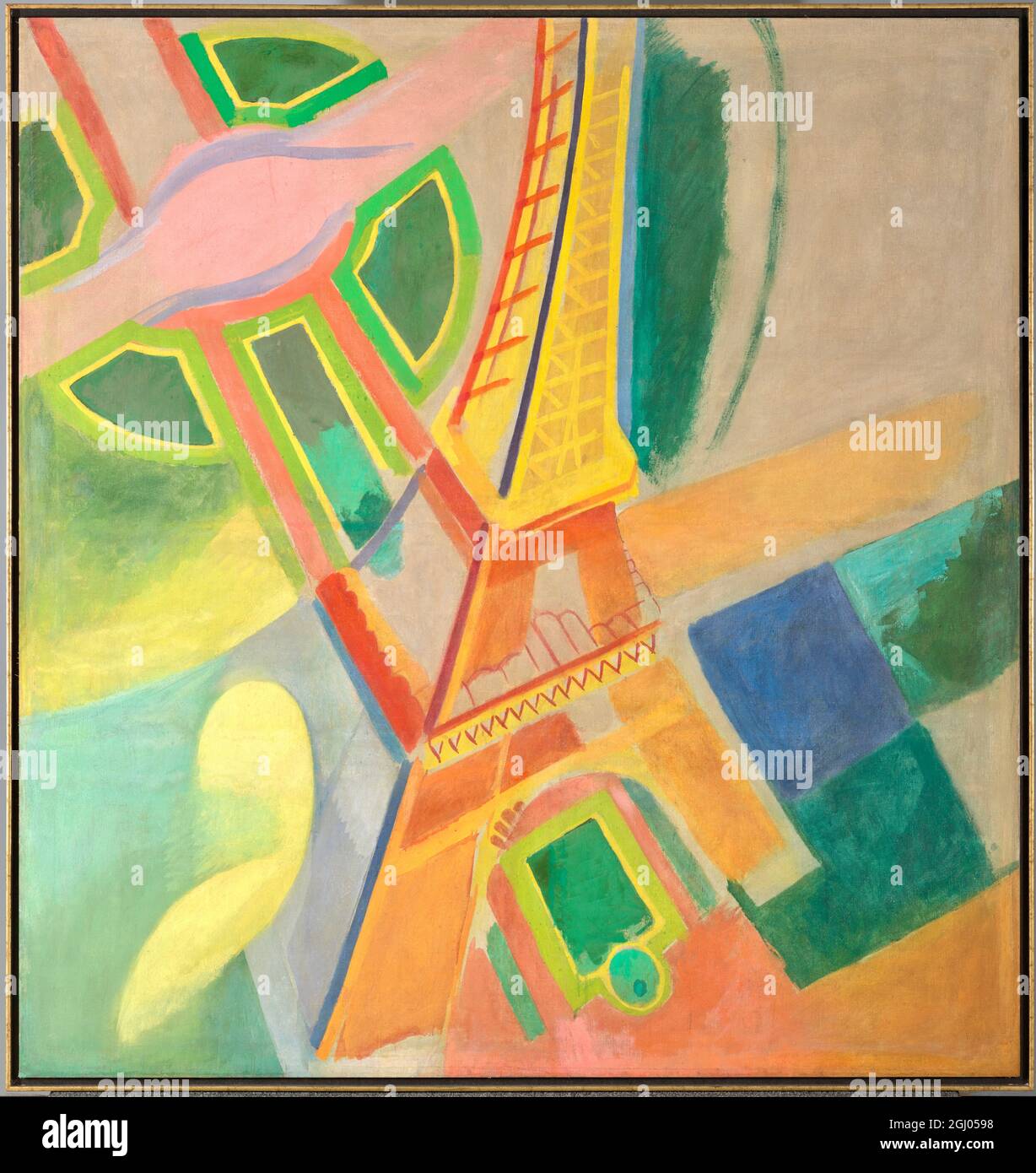
Robert Delaunay, an artist who lived in Paris between 1900 and 1940, is best known for his paintings the Eiffel Tower Series. He painted the first series between 1909 and 1912 and a second series between 1920 and 1930. This painting from 1924 is from the second series where Delaunay paints in a style known as Orphic Cubism, where color is used to envision form through planes and lines of contrasting colors. As Delaunay wrote in his journal, the Eiffel Tower was the “barometer of [his] art, ” a symbol of Paris and its success as a modern haven. Delaunay saw the Eiffel Tower as the pride of France as the country stepped boldly into the modern age. Like other artists that relayed their urban experiences by painting cityscapes, Delaunay used the structure as a template upon which he conveyed his imagined visions and perceptions of Paris. Unlike the German Expressionists’ typically chaotic and dark paintings of urban scenes, Delaunay’s post-war Eiffel Tower series celebrates the enthusiastic feeling for progress that the modern metropolis would allow. By 1924 Paris was a center of innovation and recreating the Eiffel Tower as he imagined it allowed Delaunay to communicate his own optimism for modern life - WUDG