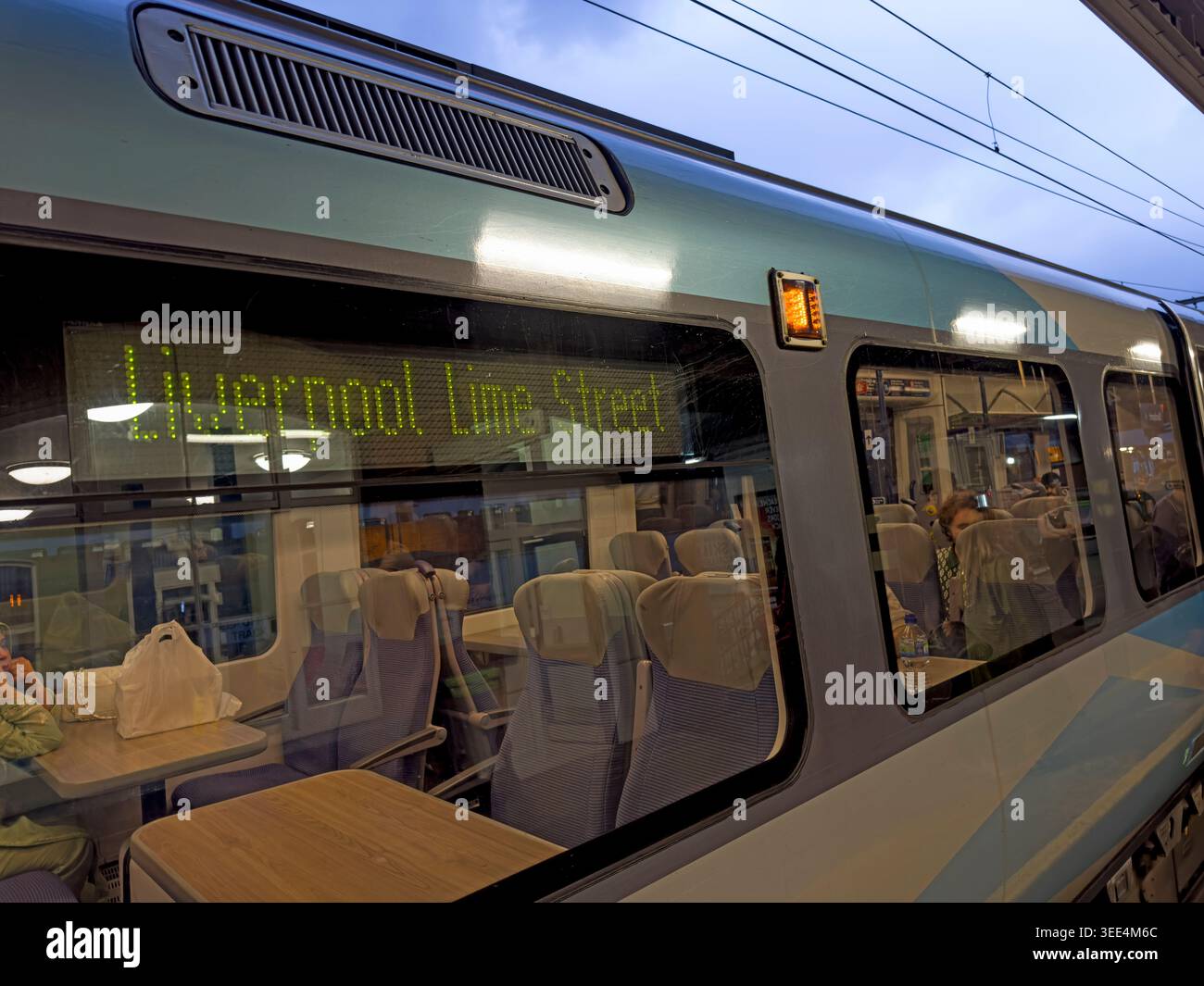
Train de passagers TransPennine Express TPE à destination de Liverpool Lime Street au crépuscule, illustrant les voyages ferroviaires en soirée dans le nord-ouest de l'Angleterre.
6401 x 4801 px | 54,2 x 40,6 cm | 21,3 x 16 inches | 300dpi
Date de la prise de vue:
20 juillet 2024
Lieu:
Liverpool Lime Street, Liverpool, Merseyside, England, UK
Informations supplémentaires:
A westbound TransPennine Express passenger train bound for Liverpool Lime Street is seen at dusk, with the illuminated LED destination display showing “Liverpool Lime Street” through the carriage window. Passengers are already seated inside the modern train as evening light fades around the station, giving the photograph a strong sense of real-life rail travel after dark in North West England. Reflections in the large windows, interior lighting, platform detail and overhead electrification place the scene firmly within Britain’s contemporary railway network. Liverpool Lime Street is the principal main-line railway terminus serving Liverpool city centre and one of the key rail gateways to Merseyside. The station opened on 15 August 1836 during the formative years of Britain’s railway age and has developed through repeated expansion and modernisation. Its position at the heart of Liverpool connects the city with destinations across northern England, the Midlands, London and Scotland. Network Rail records nearly 20 million passenger visits a year and identifies TransPennine Express among the operators serving the station. The photograph captures the everyday experience of inter-city and regional public transport rather than simply the exterior of a train: passengers visible through the windows, tables and seating prepared for the journey, bright interior lighting contrasting with the blue-hour sky, and the destination sign confirming the westbound end point. TransPennine Express forms part of the wider rail network linking major cities and towns across northern England and into Scotland, while Liverpool Lime Street is an important terminus on Network Rail’s North West route. The scene therefore documents evening mobility, rail commuting and longer-distance passenger travel in a major English city, as well as the continued importance of public transport connections between Liverpool and the wider North of England.