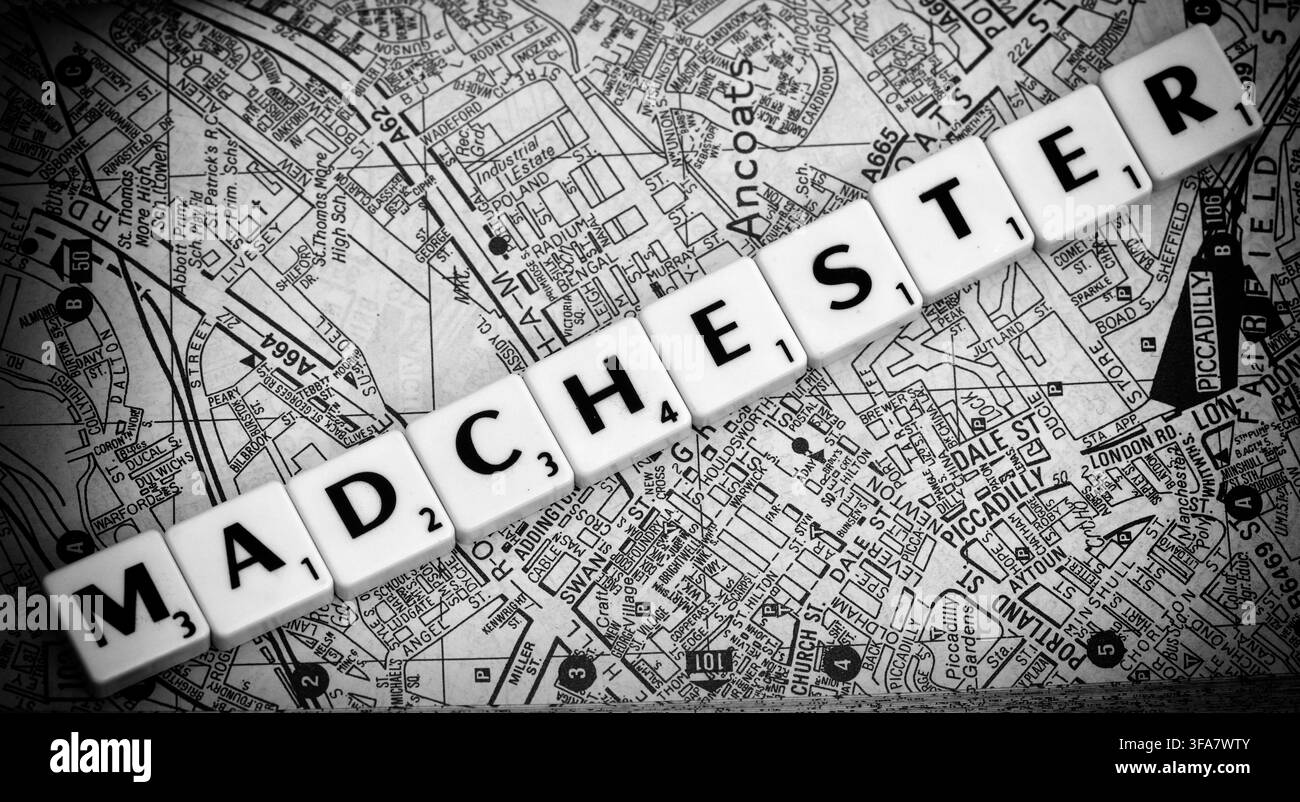
Tuiles lettres Madchester sur une carte A-Z de Manchester, évoquant Factory Records, The Haçienda, les groupes célèbres et les personnalités musicales de la ville
7183 x 3939 px | 60,8 x 33,4 cm | 23,9 x 13,1 inches | 300dpi
Date de la prise de vue:
15 août 2026
Lieu:
Manchester, Greater Manchester, England, UK
Informations supplémentaires:
Conceptual editorial still life spelling “MADCHester” in cream Scrabble-style letter tiles across a black-and-white A–Z street map of central Manchester, England. The simple composition turns the city’s famous Madchester nickname into a graphic celebration of Manchester as a music city, linking geography, bands, clubs, record labels, DJs, designers and larger-than-life Mancunian personalities. Madchester grew from the late-1980s and early-1990s collision of indie rock, acid house, rave and club culture, with Happy Mondays and The Stone Roses at its heart and Inspiral Carpets, James and The Charlatans closely associated with the wider scene. Factory Records and The Haçienda provided much of the cultural backdrop, driven by Tony Wilson, Alan Erasmus and Rob Gretton, with Martin Hannett’s production, Peter Saville’s graphic design and Ben Kelly’s club interiors helping create a distinctive Manchester identity. Joy Division and New Order form the crucial earlier Factory lineage, with Ian Curtis, Bernard Sumner, Peter Hook, Stephen Morris and Gillian Gilbert becoming enduring names in the city’s musical story. The map also invites a broader reading of Manchester music beyond Madchester: Buzzcocks and Howard Devoto from the punk era; The Smiths with Morrissey and Johnny Marr; Shaun Ryder and Bez as instantly recognisable Happy Mondays personalities; Ian Brown, John Squire and Mani from The Stone Roses; and, later, Oasis with Liam and Noel Gallagher carrying Manchester swagger around the world. DJs including Mike Pickering, Graeme Park and Dave Haslam helped define The Haçienda’s dancefloor culture. The image can illustrate Madchester nostalgia, Factory Records, Manchester bands, alternative music, Britpop, post-punk, rave, club culture, music tourism, city branding and the enduring idea of Manchester as a place where music, attitude and identity are inseparable, from the Lesser Free Trade Hall mythology through Factory and Madchester to the Britpop generation.