. Construction, théorie et pratique du chemin de fer; un livre de texte à l'usage des étudiants dans les collèges et les écoles techniques . le chargement et le déchargement au terminal de fret principal. Les voitures sont amenées à ces verges quelque temps sur des flotteurs (comme cela est fait beaucoup à divers endroits autour du port de NewYork), ou elles sont faites sur un long parement ronninglpeut-être dans les rues de la ville. Mais la caractéristique essentielle de ces yards est l'utilisation maximale de chaque pied carré d'espace de yard, qui est toujours très précieux et qui est frequentlyd'une forme si peu pratique qu'une grande ingéniosité est requise à obtai
1029 x 2428 px | 17,4 x 41,1 cm | 6,9 x 16,2 inches | 150dpi
Informations supplémentaires:
Cette image peut avoir des imperfections car il s’agit d’une image historique ou de reportage.
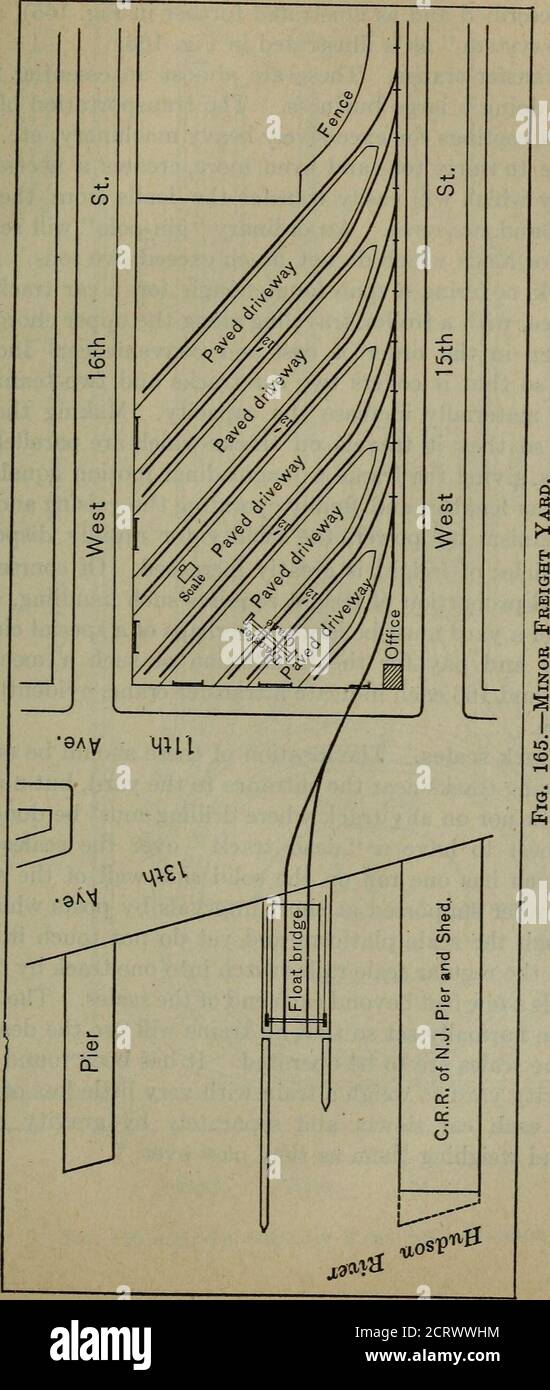
. Railroad construction, theory and practice; a text-book for the use of students in colleges and technical schools . ading and unloading at the mainfreight terminal. The cars are brought to these yards sometimeson floats (as is done so extensively at various points around NewYork Harbor), or they are run do^Ti on a long siding runninglperhaps through the city streets. But the essential feature offthese yards is the maximum utilization of every square foot ofyard space, which is always very valuable and which is frequentlyof such an inconvenient shape that a great ingenuity is requiredto obtain good results. There is generally a temptation to useexcessively sharp curves. When the radii are greater than 175feet no especial trouble is encountered. Curves wdth radius asshort as 50 feet have been used in some yards. On such curvesthe long cars now generally used make a sharper angle with eachother than that for which the couplers were designed and spe-cial coupler-bars become necessary. The two general methodsof construction are (a) a series of parallel team tracks (as pre- §381 YARDS AND TERMINALS. 407. 408 RAILROAD CONSTRUCTION. § 382. viously described and as illustrated further in Fig. 165), and (h)the loop system/ as is illustrated in Fig. 166. 382. Transfer cranes. These are almost an essential featurefor yards doing a large business. The transportation of built-up girders, castings for excessively heavy machinery, etc., whichweigh five to thirty tons and even more, creates a necessity formachinery which will easily transfer the loads from the car tothe truck and vice versa. An ordinary gin-pole will serve thepurpose for loads which do not much exceed five tons. A fixedframework, covering a span long> enough for a car track and ateam space, with a trolley traveling along the upper chord, is thenext design in the order of cost and convenience. Increasingthe span so that it covers two car tracks and two team spaceswill very materially increase the capacity. Mak